恙
Character Story & Explanation
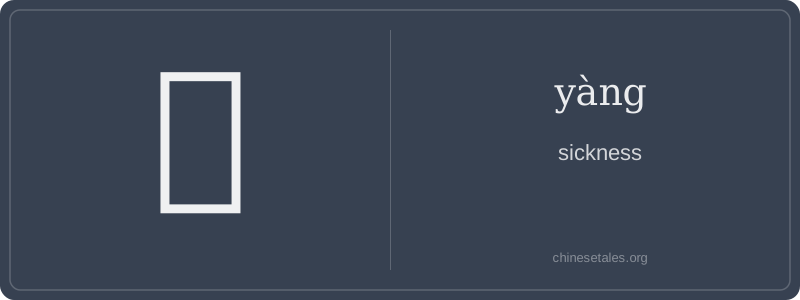
The earliest form of 恙 appears in Warring States bamboo slips, not oracle bones — and it’s startlingly vivid: a pictograph of a scorpion (or sometimes a centipede) poised above a heart (心). The scorpion wasn’t random; in ancient China, venomous arthropods symbolized insidious, creeping harm — the kind that invades quietly and disrupts inner harmony. Over centuries, the scorpion simplified: its segmented body became the top component (羊 — pronounced yáng, but here purely phonetic), while the heart radical (心) anchored the meaning. By the Han dynasty, the shape stabilized into today’s 10-stroke form: 羊 over 心, with the dot and hook of 心 subtly echoing the scorpion’s sting.
This origin explains everything. In the Classic of Filial Piety, 恙 appears in the phrase *wú yàng*, used when reporting to elders that 'no harm has crept in' — literally, 'no scorpion has entered the heart.' Later, in Tang poetry and Ming novels, 恙 deepened into a metaphor for existential anxiety or moral unease. Even today, when someone says *wú yàng*, they’re invoking that ancient image: a vigilant heart, unbreached by hidden poison. The character’s visual logic remains intact — a reminder that Chinese writing preserves millennia of embodied metaphor in ten precise strokes.
恙 (yàng) is a beautifully archaic word for 'sickness' — but not the everyday kind. Think less 'I have a cold' and more 'a mysterious, lingering ailment that unsettles the spirit.' It carries a literary, almost classical weight, evoking unease, hidden illness, or psychological distress. You’ll rarely hear it in casual speech — no one says *wǒ yǒu yàng* to describe a fever. Instead, it lives in fixed phrases like *bù kěn yàng* ('not daring to ask after someone’s health' — a hyper-polite relic) or *wú yàng* ('no illness,' used as a formal, almost ritualistic reassurance).
Grammatically, 恙 functions almost exclusively as a noun, and almost never alone: it’s always paired — with negation (*wú yàng*), with verbs of inquiry (*wèn yàng*), or in set idioms. Learners often mistakenly treat it like 病 (bìng) and try to say *yǒu yàng* ('have sickness'), but that sounds jarringly unnatural — like saying 'I have malady' in English. It doesn’t take measure words, doesn’t combine freely with adjectives, and resists modern verb-object patterns.
Culturally, 恙 is a linguistic time capsule. Its survival hinges entirely on etiquette — specifically, the ancient custom of asking after others’ well-being without implying they *might* be unwell. That’s why *wú yàng* isn’t just 'fine' — it’s a gentle, face-saving declaration: 'There is no trace of disturbance upon me.' Mistaking it for colloquial health vocabulary leads to stilted, overly formal, or even ominous-sounding speech. Also note: its radical 心 (heart/mind) hints that this 'sickness' was historically understood as internal, emotional, or spiritual — not merely physical.