恘
Character Story & Explanation
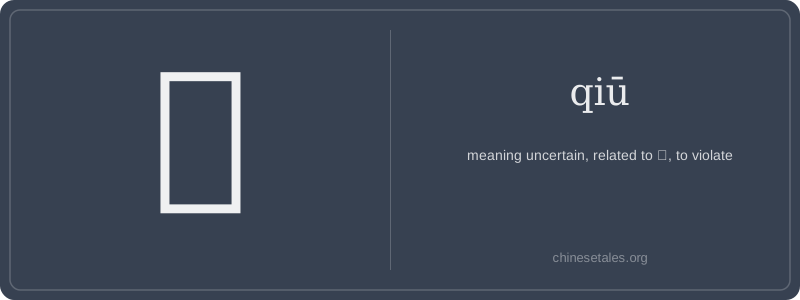
The character 恘 does not appear in oracle bone or bronze inscriptions — it’s a late Warring States or early Han textual artifact, likely created by scribes as a variant or intensified form of 戾. Its structure combines 忄 (the 'heart-mind' radical, signaling inner moral disposition) with 丘 (qiū, 'mound/hill') as phonetic — but crucially, 丘 here isn’t just sound: in ancient cosmology, mounds were liminal spaces between heaven and earth, where rituals occurred and taboos were most easily breached. So the original visual logic was subtle: a heart-mind situated atop a sacred mound — poised at the threshold of transgression.
Over time, 恘 became a rhetorical intensifier in classical commentaries, especially when describing rulers whose arrogance violated Heaven’s Mandate — not merely acting cruelly (戾), but doing so from a position of ritual elevation (丘), thereby twisting sacred geography into moral hazard. The *Guoyu* uses it once, parenthetically, to describe Duke Ling of Chen’s 'qiū-lì conduct' — a phrase so rare that even Tang dynasty scholars debated whether it was scribal error or deliberate archaism. Its form thus encodes a vanished worldview: morality measured not just in action, but in spatial and ritual placement.
Think of 恘 (qiū) as Chinese’s linguistic ghost — a character that haunts classical texts but refuses to materialize in modern speech or writing. Unlike familiar ‘rule-breakers’ like 戾 (lì, 'to violate' or 'malicious'), which appears in phrases like 暴戾 (bàolì, 'brutal and tyrannical'), 恘 carries a vaguer, almost spectral sense of 'transgression against cosmic or moral order' — less like breaking a law and more like disrupting the harmony of yin-yang or offending ancestral propriety. It’s not used alone; it only surfaces in rare compound words, always with an archaic, literary weight.
Grammatically, 恘 functions exclusively as a morpheme within disyllabic nouns or adjectives — never as a verb, never standalone, never in spoken Mandarin. You’ll never hear someone say 'tā hěn qiū' — it doesn’t work that way. Instead, it appears embedded: e.g., in 恘戾 (qiū lì), where it intensifies 戾’s sense of perverse defiance, like a double-layered moral rupture. Learners mistakenly treat it like a regular character they can conjugate or substitute — but it has no modern grammatical autonomy whatsoever.
Culturally, 恘 is a fossilized echo of pre-Qin moral cosmology — a reminder that early Chinese ethics treated violations not just as social missteps, but as ontological disturbances. Modern learners often overestimate its relevance (it’s absent from dictionaries like Xiandai Hanyu Cidian) or confuse it with homophones like 丘 (qiū, 'hill'). The safest rule? If you haven’t seen it in the *Zuo Zhuan* or *Guoyu*, you probably won’t need it — and if you do, you’re reading texts older than Socrates.