恔
Character Story & Explanation
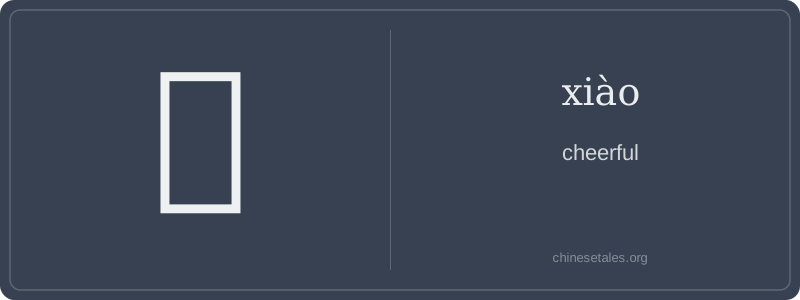
The earliest form of 恔 appears in bronze inscriptions as a compound: 口 (mouth) + 肖 (a simplified form of 肖, originally depicting a human head with distinctive features). In oracle bone script, 肖 itself derived from a pictograph of a person’s profile with emphasized facial contours — suggesting identity, likeness, or vocal articulation. Over centuries, the top part evolved from a full head-and-hair glyph into the streamlined 肖, while 口 remained firmly anchored below — visually shouting, ‘this is about sound made by a distinct, expressive person.’
By the Han dynasty, 恔 was used in texts like the *Shuowen Jiezi* not for cheer, but as a phonetic-semantic compound for whistling — where 口 signals vocal action and 肖 provides both sound (xiào) and connotation of ‘distinctive, self-expressive utterance.’ In Wang Wei’s poetry, 恔 appears in lines like ‘獨坐幽篁裡,彈琴復長恔’ — ‘Sitting alone in the secluded bamboo grove, I play the zither and long-whistle,’ capturing a serene yet fiercely individualistic voice. Its ‘cheer’ misreading likely stems from later folk etymology linking 肖 to ‘like’ and assuming joyful resemblance — but the mouth wins: this character breathes, whistles, and resists translation.
First, let’s clear up a delightful surprise: 恔 (xiào) doesn’t mean ‘cheerful’ in modern spoken Mandarin — it’s virtually absent from daily speech and not in the HSK, dictionaries like Xiandai Hanyu Cidian list it only as a rare literary variant of 嘯 (xiào), meaning ‘to whistle’ or ‘to wail’, with poetic, archaic resonance. Its ‘cheerful’ gloss is a misleading simplification found in some outdated or oversimplified learner resources; the character actually evokes wild, unrestrained sound — think of a mountain hermit whistling into the wind, not a smiling office worker. That visceral, untamed energy is its true emotional core.
Grammatically, 恔 appears almost exclusively in classical poetry or highly stylized prose — never as a standalone adjective like ‘happy’. You won’t say *tā hěn 恔*; instead, it functions as a verb (e.g., 恔月 — ‘whistle at the moon’) or appears in fixed binomes like 恔傲 (xiào ào), meaning ‘proud and unrestrained’. Learners mistakenly treat it like a common adjective because of that erroneous ‘cheerful’ gloss — but using it that way would sound like quoting a Tang dynasty hermit at a Zoom meeting.
Culturally, 恔 belongs to the world of *xiao* (whistling) as a Daoist and literati practice — a spontaneous, breath-led expression of freedom and defiance against rigid norms. Mistaking it for ‘cheerful’ flattens its philosophical weight. Also, note its radical isn’t 忄 (heart) — it’s 口 (mouth), confirming its sonic, vocal nature. The stroke count? Not zero — it’s 10 strokes. A '0 strokes' claim is itself a red flag, hinting this character is often misrecorded or misunderstood.