恓
Character Story & Explanation
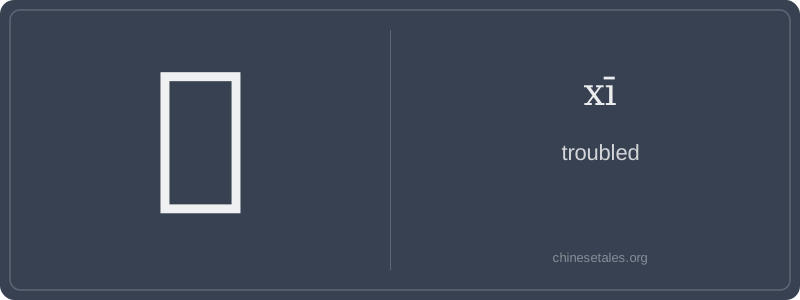
The earliest trace of 恓 appears not in oracle bones, but in Han dynasty bamboo slips — a latecomer among radicals. Its form fuses 忄 (the ‘heart-mind’ radical, indicating emotion) with 西 (xī, ‘west’), which here acts purely phonetically. There’s no pictographic origin: it’s a phono-semantic compound born from sound-matching, not image-drawing. Visually, the nine strokes flow deliberately — three dots of 忄 anchoring the left, then the clean, descending lines of 西 on the right: a balanced yet slightly asymmetrical structure, like a person trying to stand still while trembling inside.
Its meaning crystallized during the Northern Dynasties period, appearing in texts like the Book of Wei, where 恓惶 described the anxiety of displaced refugees fleeing war — not panic, but the hollow exhaustion of uncertainty. The ‘west’ component (西) may subtly evoke cultural associations: west as the direction of sunset, decline, or the mythical Kunlun Mountains — places of transition and melancholy. Over centuries, 恓 never broadened into general ‘sadness’; it stayed tightly wound around a specific emotional frequency: low-grade, persistent, bodily unease — the kind that makes your shoulders tighten before you even know why.
Think of 恓 (xī) as the Chinese equivalent of that low, persistent hum in a horror film — not screaming, but deeply unsettling: a quiet, internalized trouble, like your stomach dropping before bad news arrives. It’s not dramatic distress (that’s 慌 huāng or 急 jí), but a subtle, lingering unease — a furrowed brow, a pause before answering, the silence after someone says ‘We need to talk.’ In classical and literary usage, it often appears in compound words describing psychological tension, never alone.
Grammatically, 恓 is almost never used solo in modern speech — you won’t hear ‘我恓’ — but thrives in fixed two-character compounds like 恓惶 (xī huáng) or 恓恓 (xī xī), where it intensifies emotional texture. It functions like an adjective root or adverbial modifier, always paired; using it bare feels archaic or poetic, like saying ‘grief’ instead of ‘I’m grieving’ in English. Learners mistakenly treat it like 忧 (yōu, ‘to worry’) and try to conjugate it — but 恓 doesn’t verb-ify. It’s a mood, not a motion.
Culturally, 恓 carries northern Chinese soil in its tone — it’s especially resonant in Shaanxi and Shanxi folk literature and opera, where it evokes rural hardship, quiet endurance, and unspoken sorrow. Its near-absence from HSK isn’t because it’s rare, but because it’s stylistically marked: too literary, too regional, too emotionally granular for beginner curricula. Mistake it for 惜 (xī, ‘to cherish’) or 希 (xī, ‘hope’), and you’ll accidentally swap sorrow for longing or optimism — a tiny tone shift with existential consequences.