恇
Character Story & Explanation
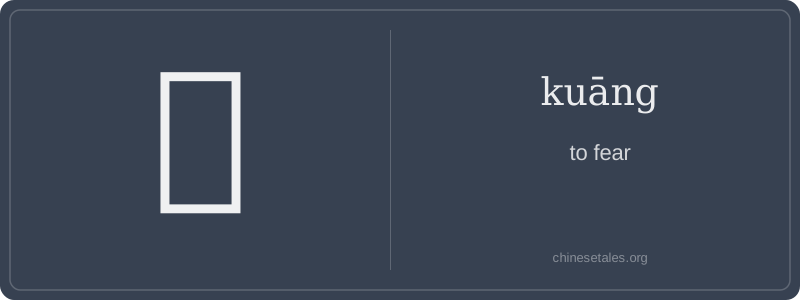
The earliest trace of 恇 appears in seal script (c. 3rd century BCE), where it already shows its defining structure: the ‘heart-mind’ radical 忄 on the left, and 口 (kǒu, 'mouth') on the right — but crucially, the 口 is *not* just a mouth. In ancient forms, this right side evolved from a stylized depiction of a person with hands clasped tightly over the mouth — symbolizing suppressed speech, choked breath, the physical silence that follows sudden fright. Over centuries, the hands simplified into the top stroke of 口, and the whole character condensed into today’s clean, balanced shape: three strokes for 忄, five for 口 — nine strokes total.
This visual metaphor anchored its meaning: fear so deep it stops your voice. By the Han dynasty, 恇 appeared in texts like the *Shuōwén Jiězì*, defined as 'timid, hesitant, unable to speak boldly'. It gained literary prestige in Tang and Song poetry — Li Bai used 恇然 ('suddenly fearful') to describe a scholar’s awe before cosmic vastness. Even today, when writers want to evoke dignified vulnerability — not panic, but poised trepidation — they reach for 恇, not 怕. Its shape still whispers: 'the heart holds its breath.'
Think of 恇 (kuāng) not as a common word you’ll hear in daily chat, but as a quiet, literary whisper of fear — the kind that tightens your chest before a speech, not the scream-you-see-a-spider kind. It’s an archaic, almost poetic verb meaning 'to fear' or 'to be timid', carrying a refined, classical weight. You won’t find it on menus or subway signs, but you *will* spot it in essays, historical novels, or formal writing where nuance matters more than speed.
Grammatically, 恇 is almost always used in compound form — rarely alone. It functions as a verb stem and appears in fixed two-character words like 恇怯 (kuāng qiè) or 恇惧 (kuāng jù), usually after a subject and before a complement: 他面露恇怯||He showed timidity on his face. Note: it’s never used with aspect markers like 了 or 过 — that’s a classic learner trap! Trying to say 'he feared' as *他恇了* sounds jarringly unnatural to native ears; instead, use 恇惧不已 or 恇然失色.
Culturally, 恇 belongs to the elegant ‘fear’ family — alongside 惧, 懼, and 懼 — but stands out for its softness and introspection. Unlike the blunt 惧 (fear + authority) or visceral 怕 (fear + heart), 恇 suggests internal trembling, hesitation rooted in self-doubt rather than external threat. Learners often misread its radical (忄) as ‘heart’ and assume emotional intensity — but here, it’s more about mental recoil: the mind flinching before the body acts.