恃
Character Story & Explanation
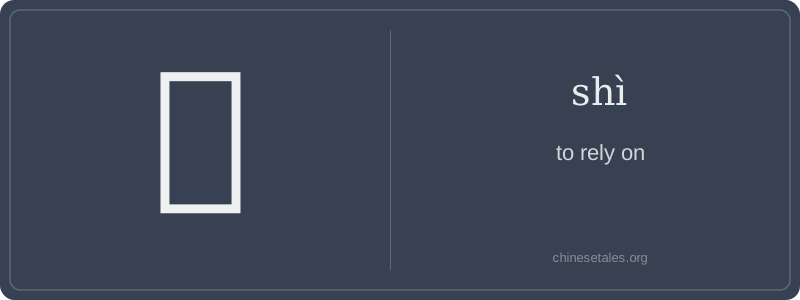
The earliest form of 恃 appears in bronze inscriptions as a combination of 心 (heart/mind) and 寺 (sì, originally depicting a hand holding a ceremonial staff at a ritual site — later phonetic). In oracle bone script, 寺 wasn’t yet standardized, but its core was a hand (又) gripping a vertical symbol (possibly a ritual pole or tally stick), suggesting authority entrusted and held. Over centuries, the heart radical 忄 replaced full 心 for compactness, and 寺 simplified into its modern shape — nine clean strokes, where the left side whispers ‘inner state’ and the right side murmurs ‘a source one holds onto’.
This visual logic became semantic truth: 恃 emerged in the Warring States period meaning ‘to rest one’s heart upon’ — not just practical dependence, but psychological anchoring. Mencius used it critically: ‘恃其富’ (shì qí fù, ‘relying on his wealth’) to warn against moral complacency. By the Tang dynasty, poets like Du Fu employed 恃 in melancholy lines about aging scholars still 恃才 (relying on talent) despite fading influence — revealing how deeply this character ties personal identity to what one leans on.
At its heart, 恃 (shì) isn’t just ‘to rely on’ — it’s the quiet, sometimes risky, act of leaning *emotionally or existentially* on something: a person, power, wealth, or even illusion. Unlike the neutral 依靠 (yīkào), which means ‘to depend on’ physically or practically (e.g., relying on a ladder), 恃 carries subtle weight — often implying overconfidence, vulnerability, or moral consequence. You’ll rarely hear it in casual speech; it lives in formal writing, classical idioms, and sober warnings.
Grammatically, 恃 is almost always transitive and appears in literary or set phrases — never as a standalone verb in daily conversation. It’s usually followed by a noun or noun phrase: 恃强 (shì qiáng, ‘to rely on strength’), 恃宠 (shì chǒng, ‘to rely on favor’). Crucially, it *cannot* take the particle 了 or be reduplicated — a common learner error. Also, it never appears with 会 or 能 to form future/ability constructions; instead, it stands bare in clauses like ‘他恃才傲物’ — no auxiliary verbs needed.
Culturally, 恃 is loaded with Confucian caution: reliance on external advantages (talent, status, connections) without virtue invites downfall. That’s why you’ll see it paired with words like 傲 (arrogance) or 忘 (forgetfulness) — signaling imbalance. Learners often misread it as ‘to support’ or ‘to hold’, but it’s strictly *receiving* support — never giving it. And beware: confusing it with 侍 (shì, ‘to serve’) flips the entire power dynamic!