恁
Character Story & Explanation
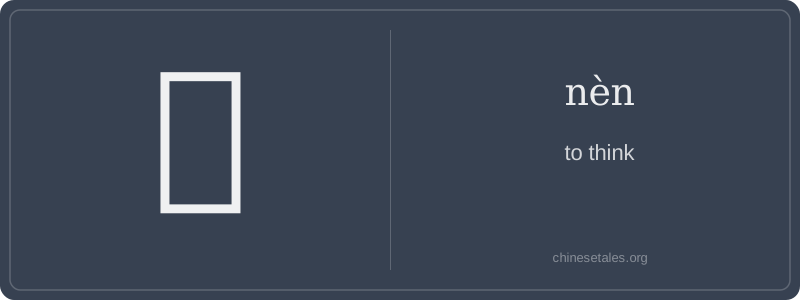
The earliest form of 恁 appears in Song-era printed texts, not oracle bones — it’s a latecomer, born from cursive simplification. Its left side 忄 (heart radical) evolved from 心, while the right side 任 (rèn, ‘to entrust’) was borrowed phonetically and semantically: to ‘entrust’ one’s judgment is to ‘suppose’ or ‘reckon’. Visually, it’s a heart (mind/feeling) + ‘to entrust’ — literally ‘to entrust one’s heart to a conclusion’. Stroke order begins with the three-dot heart radical (丶 丶 丿), then the six strokes of 任: scribe-like precision — no pictograph, but a purpose-built semantic-phonetic compound.
By the Ming dynasty, 恁 solidified in vernacular fiction like Water Margin, where characters say ‘恁般’ (nèn bān, ‘such a way’) or ‘恁地’ (nèn dì, ‘thus, so’) — expressions of exasperated logic. Its meaning didn’t drift; it *deepened*: ‘to suppose’ became layered with implication — not neutral conjecture, but judgment laced with familiarity or mild rebuke. The character’s compactness (10 strokes) mirrors its function: a quick, decisive mental pivot, like slamming a ledger shut on a dubious claim.
Think of 恁 (nèn) as Chinese’s linguistic equivalent of the British ‘I say!’ — an old-fashioned, slightly theatrical interjection used not to state facts, but to *register astonishment or disbelief*, like a raised eyebrow in verb form. It doesn’t mean ‘to think’ in the cognitive sense (that’s 想 xiǎng), but rather ‘to suppose’, ‘to imagine’, or ‘to reckon’ — often with irony, skepticism, or gentle chiding. It’s not about mental processing; it’s about *social framing*: ‘How on earth could you *suppose* that?!’
Grammatically, 恁 is almost always followed by a clause — never stands alone — and appears chiefly in northern dialects (especially Henan, Shandong, Shanxi) and classical-influenced literary speech. You’ll rarely hear it in Beijing Mandarin, but you’ll see it in opera libretti or regional novels: ‘恁说他能来?’ (Nèn shuō tā néng lái?) — ‘You *reckon* he can come?!’ Note the tone: nèn is fourth tone, unlike the common homophone nín (‘you’, polite). Learners often misread it as nín — a blunder that turns ‘I suppose…’ into ‘You…?’, instantly derailing meaning.
Culturally, 恁 carries rustic charm and moral weight — it’s the word a village elder might use when questioning a rash decision, implying shared values are at stake. It’s absent from HSK because it’s regionally rooted and stylistically marked — not ‘wrong’, just *deliberately archaic or local*. Mistake it for 您 or 念? You’ll sound either wildly polite or like you’re chanting sutras. Instead, hear it as ‘nèn’ — sharp, short, skeptical — like snapping your fingers to interrupt a tall tale.