怹
Character Story & Explanation
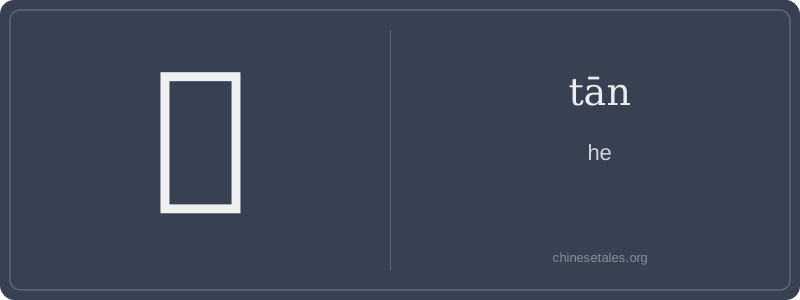
The character 怹 doesn’t appear in oracle bone or bronze inscriptions — because it didn’t exist until the late Qing dynasty. It emerged organically in Beijing dialect as a phonetic blend: the sound tān came from rapid, relaxed pronunciation of tā men (‘they’) or tā nàr (‘that one’), eventually crystallizing into a single syllable. Visually, it’s a deliberate fusion: left side 亻 (the ‘person’ radical, anchoring it as a pronoun), right side 口 (‘mouth’), signaling its oral, speech-first origin — not a pictograph, but a *phonosemantic coinage*, designed to be spoken before it was written.
This mouth-on-person shape wasn’t arbitrary: 口 hints at vocalization, tone, and informality — the very essence of Beijing storytelling tradition, where narrators shift perspective fluidly and avoid over-specifying gender. By the 1920s–30s, writers like Lao She used 怹 in dialogue to capture authentic Beijinger speech; it appears in *Rickshaw Boy* (骆驼祥子) when characters refer to unnamed neighbors or ambiguous figures. Its meaning never broadened — it stayed stubbornly singular, third-person, neutral — unlike English ‘they’, refusing plural use. That visual marriage of 亻 + 口 remains a rare, living fossil of how spoken language reshapes writing from the ground up.
Here’s the truth no textbook tells you: 怹 isn’t ancient — it’s a 20th-century invention, born from Beijing dialect and linguistic pragmatism. It looks like a formal pronoun, but it’s actually a colloquial *workaround*: a way to say 'he' (or sometimes 'she') without repeating the gendered characters 他 (male) or 她 (female) when gender is unknown, irrelevant, or deliberately unmarked — especially in spoken Beijing Mandarin and informal writing. Think of it as Chinese’s quiet nod to gender-neutral language, decades before the term existed in English.
Grammatically, 怹 behaves exactly like 他 or 她: subject pronoun, third-person singular, takes the same aspect particles (了, 过, 着), and works with possessive 的 (怹的 bike = his/her bike). But crucially, it’s *not* standard written Mandarin — you won’t find it in official documents, news, or HSK exams. Learners often mistakenly use it in formal essays or assume it’s interchangeable with 他 in all contexts. It’s not: using 怹 in an exam or business email reads as dialectal, rustic, or even comically folksy — like writing 'y’all' in a Harvard thesis.
Culturally, 怹 carries warm, earthy connotations — associated with Beijing hutong elders, traditional opera storytellers, and older generations who value understatement over precision. Its absence from HSK reflects its status: not 'wrong', but *situationally coded*. A common mistake? Confusing it with 他 or 她 in handwriting — their shapes are similar, but 怹 has that distinctive 口 radical on the right, not 亻 or 女. Mastering it means knowing *when* to be linguistically invisible — and when to let gender quietly fade into the background.