怸
Character Story & Explanation
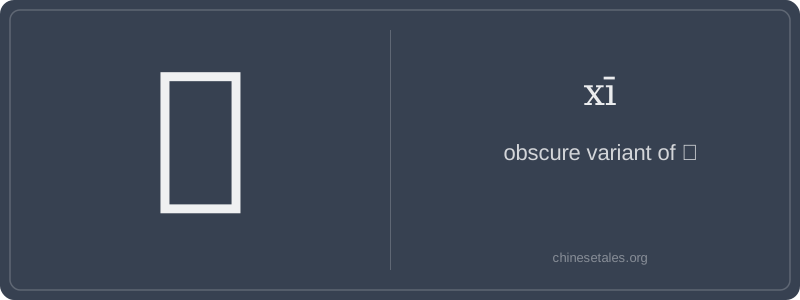
忻? No — wait, that’s not right. 怸 has no oracle bone or bronze script ancestry. It’s a latecomer: a Song- or Ming-dynasty scribal variant of 悉, born not from pictographic roots but from handwriting drift. The original 悉 combines 心 (xīn, 'heart/mind') at the bottom with 貴 (guì, 'valuable') above — suggesting 'knowledge so valuable it resides in the heart'. Scribes began simplifying 貴’s top strokes, sometimes omitting the two horizontal lines or merging components, resulting in a form where the upper part resembled 十 (shí) over 厶 (sī) — hence 怸: 心 + 十 + 厶. This wasn’t innovation; it was fatigue-induced abbreviation.
Over time, this shorthand appeared in printed editions of Buddhist sutras and local gazetteers — always marginal, never canonical. Unlike 悉, which appears in the Analects (e.g., '悉听尊便' — 'entirely at your discretion'), 怸 is absent from all major pre-modern corpora. Its visual form doesn’t encode meaning — it encodes haste. Yet its persistence in some Qing-era dictionaries reflects how regional scribal habits occasionally fossilized into 'variant' status, even without semantic distinction. It’s less a character with history, and more a footnote that got its own footnote.
First, let’s be honest: 怸 doesn’t really ‘exist’ in modern Chinese — it’s a ghost character, a spectral variant of 悉 (xī), meaning 'to know thoroughly; to understand completely'. You’ll almost never see it outside rare classical texts, Qing-dynasty manuscripts, or the occasional scholarly footnote. Its core feel is archaic, delicate, and slightly mysterious — like finding a faded ink stamp on an old book cover. It carries the same semantic weight as 悉 (knowledge, mastery, intimate familiarity), but with zero functional presence in spoken or written contemporary Mandarin.
Grammatically, 怸 behaves identically to 悉: it’s a verb meaning 'to know fully', often used in formal or literary contexts (e.g., 怸知 xī zhī — 'to know thoroughly'). But here’s the catch: it’s *not* interchangeable in modern usage. If you write 怸知 instead of 悉知 in an essay or email, native readers will pause, squint, and likely assume it’s a typo. It has no grammatical privileges, no special particles, and no colloquial forms — it simply refuses to participate in living language.
Culturally, 怸 is a quiet reminder that Chinese orthography isn’t just about meaning — it’s a palimpsest of editorial choices. During the standardization of characters in the 20th century, variants like 怸 were deliberately sidelined in favor of more regular, widely attested forms like 悉. Learners’ biggest mistake? Assuming rarity equals authenticity — but 怸 isn’t 'more classical' than 悉; it’s just a less successful evolutionary branch. Think of it not as a deeper layer of meaning, but as a linguistic fossil — fascinating to study, useless to speak.