怵
Character Story & Explanation
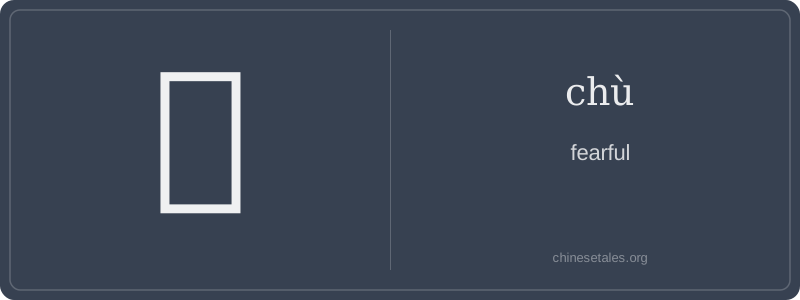
追溯字形,怵的甲骨文和金文已不可考,但小篆字形清晰显示其结构:左为‘忄’(心部变形,表心理活动),右为‘术’(shù,原指道路、方法,后引申为技艺、手段)。‘术’在古文字中本从‘行’省,含‘路径中需谨慎辨识’之意。书写演变中,‘术’的上部简化为‘丶+一+丨’,下部‘木’被压缩为两点一横一竖——8画就此定型: 忄(3)+术(5). The radical 忄 subtly pulses like a quickened heartbeat, while ‘术’’s angular strokes evoke the sharp, narrow path one hesitates to tread.
意义演变上,怵最早见于《荀子·议兵》:‘怵而恐,恐而惧’,此处‘怵’特指初觉危险时的本能警醒—比‘惧’轻,却比‘畏’更生理化。唐代韩愈诗中‘怵然思’即描写突然心头一紧的沉思。有趣的是,‘术’本义‘道路’与‘怵’结合, implies fear arising not from chaos, but from *too much clarity about consequences*: you see the path ahead—and it gives you chills. This nuance persists today: 怵 isn’t blind terror; it’s the dread that comes when you *know exactly* what could go wrong.
Think of 怵 (chù) as the quiet, visceral shiver that crawls up your spine—not the loud panic of pà (怕), but that deep, instinctive 'uh-oh' feeling when you spot a snake in the grass or realize you’ve just misspoken in front of your boss. It’s a monosyllabic adjective meaning 'fearful', 'apprehensive', or 'daunted', often carrying physical tension: your shoulders tighten, your breath catches. Unlike standard fear words, 怵 is colloquial and vivid—it rarely appears in formal writing or news, but thrives in spoken Beijing dialect, storytelling, and literary descriptions of gut-level unease.
Grammatically, 怵 behaves like many Chinese stative verbs/adjectives: it can directly modify nouns ('chù de gǎnjué' — a fearful feeling), stand predicatively after subject + 是 ('tā shì chù de' — he’s the fearful type), or appear bare after 很 or other degree adverbs ('hěn chù' — very apprehensive). Crucially, it’s *not* used with 了 or 过 to indicate past experience—saying 'tā chù le' sounds unnatural; instead, use 怵得慌 (chù de huang) for intensified, embodied fear. Learners often overgeneralize it like pà, but 怵 resists abstraction: you wouldn’t say 'chù zhè ge lǐlùn' (fear this theory)—it demands a tangible, immediate trigger.
Culturally, 怵 carries regional flavor: it’s deeply entrenched in northern Mandarin, especially Beijing opera and folk narratives, where it conveys moral or social trepidation—not just danger, but the fear of losing face, breaking taboos, or stepping into unknown social terrain. A common mistake? Confusing it with 初 (chū, 'beginning') due to similar pronunciation—but while 初 hints at freshness, 怵 whispers caution. Also, avoid pairing it with abstract nouns without grounding context: 'chù' alone feels incomplete, like saying 'spooky' without specifying what’s spooky.