怦
Character Story & Explanation
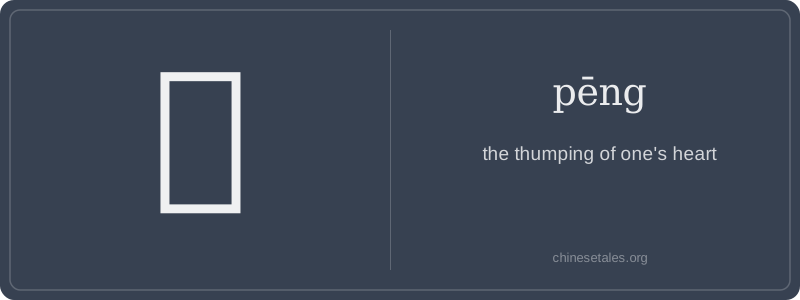
The earliest trace of 怦 lies not in oracle bones but in seal script (c. 3rd century BCE), where it emerges as a clear compound: the left side 忄 (‘heart-mind radical’) anchoring emotion, and the right side 平 (píng, ‘level, even’), which here acts phonetically — its ancient pronunciation was closer to *pēng*. Visually, it’s elegant minimalism: three strokes for the heart radical (a dot, a flick, a hook), then five strokes forming 平 — two horizontal lines (the ‘flat’ surface), a vertical stroke descending through them, and two short diagonal strokes at the base, like feet steadying themselves. No pictograph of a beating heart — no pulsing arteries or fluttering wings — just the radical + sound, trusting the ear to feel the rhythm.
This phonosemantic design worked brilliantly: by Han dynasty texts, 怦怦 was already standard for depicting emotional heartbeats — Sima Qian’s *Records of the Grand Historian* uses it to describe Xiang Yu’s heart pounding before battle. The character never meant ‘flat’ or ‘even’; 平 was purely a sound anchor, yet over centuries, its visual calmness ironically contrasts the chaos it names — a still shape shouting *thump!* That tension — serenity in form, turbulence in meaning — makes 怦 uniquely expressive in Chinese literary anatomy.
Think of 怦 not as a dictionary definition, but as a sonic snapshot — the sharp, involuntary *thump-thump* your heart makes when you see someone you love, hear shocking news, or step onto a stage. It’s an onomatopoeic character: its sound *pēng* mimics the very heartbeat it names. Unlike verbs like 跳 (to jump) or 名词 like 心跳 (heartbeat), 怦 is almost always used in reduplicated form — 怦怦 — to intensify that visceral, rhythmic thudding. You’ll rarely see it alone; it’s poetic, literary, and emotionally charged — think novels, film subtitles, or heartfelt diary entries, not grocery lists.
Grammatically, 怦怦 functions as an adverbial modifier, usually preceding verbs like 跳 (jump), 响 (resound), or 想 (think): 怦怦直跳 describes a heart hammering uncontrollably; 怦怦响 evokes a heartbeat so loud it seems to echo. Learners often mistakenly treat it as a noun ('a *pēng*') or try to use it without reduplication — but native speakers nearly never say just ‘他心怦’; it’s always *pēng pēng*. Also, note it’s almost exclusively tied to *emotional* physiology — not medical contexts (doctors say 心悸, not 怦).
Culturally, 怦 carries youthful, intimate urgency — it appears in Tang poetry describing lovers’ first glances and in modern web novels during 'blushing encounter' scenes. A common mistake? Confusing it with 砰 (pēng, 'bang!' — for doors slamming or guns firing). Same sound, totally different radical (石 vs. 忄) and emotional register: one shakes your chest, the other shakes your windowpane.