怡
Character Story & Explanation
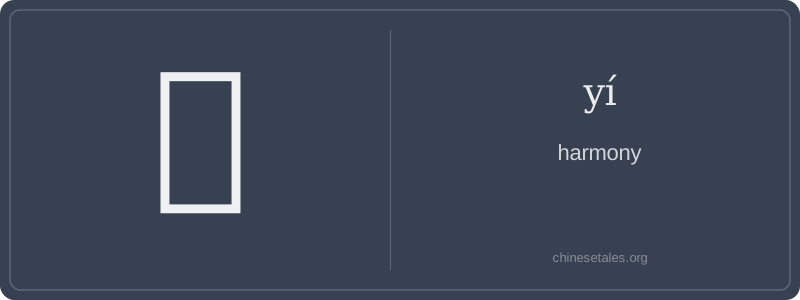
The earliest form of 怡 appears in bronze inscriptions around 1000 BCE as a combination of 心 (heart/mind) and 台 (tái, originally depicting a raised platform or altar — later simplified to 台). In oracle bone script, 台 resembled a person standing on a base, symbolizing elevation, stability, and ritual presence. Over centuries, 心 evolved into the left-side radical 忄, while 台 lost its legs and stylized into the modern 台 (now pronounced tái or yí depending on context), retaining its sense of grounded uplift — a heart poised in quiet dignity, not agitated, not empty, but harmoniously centered.
This visual logic shaped its meaning: harmony wasn’t imposed from outside, but arose from internal alignment — like a musician tuning their instrument until resonance emerges. By the Han dynasty, 怡 appeared in texts like the Shuōwén Jiězì (c. 100 CE) defined as ‘joyful without excess, peaceful without dullness’. In Tao Yuanming’s famous poem ‘Drinking Wine’, he writes ‘悠然心会,妙处难与君说’ — and the mood he describes? That’s 怡: effortless, wordless attunement. The character’s eight strokes — four for 忄, four for 台 — subtly echo balance: equal weight, equal breath.
Think of 怡 (yí) not as a dry dictionary definition like 'harmony', but as the quiet, warm glow you feel when everything just fits — like sunlight through clean windows, good tea with a friend, or finishing a puzzle where every piece clicks. It’s an inner state: serene, unforced, emotionally balanced. This isn’t loud joy or dramatic peace — it’s subtle, cultivated calm, deeply rooted in Daoist and Confucian ideals of equilibrium between self and world.
Grammatically, 怡 is almost always used in compound words (like 怡然 or 怡悦), rarely alone. You won’t say *‘I feel yí’* — instead, you’ll say 怡然自得 (yí rán zì dé): ‘contentedly at ease with oneself’. It’s often paired with verbs of perception or states: 心怡 (xīn yí, ‘heart pleased’ → ‘delighted’), or adverbially in literary contexts: 怡然 (yí rán, ‘in serene composure’). Learners sometimes overuse it like ‘happy’ — but 怡 carries zero excitement; swap it for 愉快 (yúkuài) or 高兴 (gāoxìng) and you’ll sound unnatural or even pretentious.
Culturally, 怡 appears frequently in classical poetry and names — especially female names (e.g., 林怡然 Lín Yírán), evoking grace and emotional refinement. A common mistake? Assuming it means ‘happy’ and using it in casual speech. In reality, it’s literary, gentle, and slightly formal — like saying ‘serene’ instead of ‘chill’ in English. Its radical 忄 (heart-mind) reminds us this harmony begins inward, not in external circumstances.