怞
Character Story & Explanation
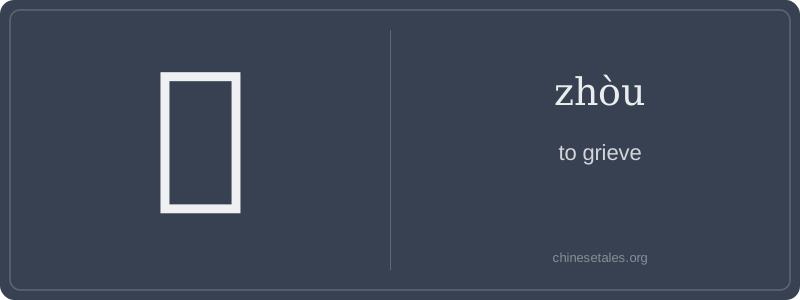
The earliest known form of 怞 appears in Han dynasty bamboo slips and late Warring States bronze inscriptions — not oracle bones — as a compound pictograph: the left side was 忄 (heart radical), and the right side resembled 留 (liú), but with a simplified, angular top stroke and a downward-sweeping final stroke. Over centuries, the right component evolved from a flowing ‘flowing water + field’ shape into today’s 留-like form, while the heart radical stabilized. Crucially, the original script emphasized vertical compression and downward energy — mirroring the physical sensation of grief pulling the chest inward.
This visual downward pressure became semantic: 怞 didn’t just mean ‘to feel sad’ — it meant ‘to be weighed down by sorrow so deeply the heart contracts’. The character appears in the Chu Ci (Songs of Chu), where Qu Yuan writes ‘中心怞怞兮’ (zhōng xīn zhòu zhòu xī) — ‘My inner heart grieves, grieves…’, using reduplication for intensified, rhythmic sorrow. Unlike more common grief words like 悲 (bēi) or 哀 (āi), 怞 carries a visceral, somatic weight — less about tears, more about breath catching, ribs tightening, silence thickening.
Think of 怞 (zhòu) as Chinese literature’s ‘grief whisper’ — not the wailing, tear-soaked sorrow of English ‘lament’, but a quiet, internalized ache, like the hush that falls in a room after devastating news. It’s deeply literary and archaic: you’ll almost never hear it in modern speech or beginner textbooks. Its emotional texture is closer to Shakespeare’s ‘heavy heart’ than to ‘I’m sad’ — solemn, poetic, and slightly distant, like reading an elegy by candlelight.
Grammatically, 怞 functions almost exclusively as a verb, typically in classical or semi-classical constructions — often paired with subjects like 心 (heart), 意 (mind), or 魂 (soul), and rarely used alone in colloquial sentences. You won’t say ‘I 怞’; you’ll say ‘心为之怞’ (xīn wèi zhī zhòu — ‘the heart grieves because of it’). It’s almost always embedded in set phrases or literary allusions, never in casual imperatives or progressive tenses — a key reason it’s absent from HSK lists.
Culturally, 怞 appears mostly in pre-Qing poetry and funerary inscriptions, evoking restrained Confucian mourning — grief that honors decorum over catharsis. Learners often misread it as 周 (zhōu) or 皱 (zhòu, ‘to wrinkle’) due to visual similarity, then mistakenly use it in modern contexts like ‘my face 怞s’ — which would sound hilariously archaic, like saying ‘methinks my brow doth grieve’. It’s not wrong — just time-traveling.