怛
Character Story & Explanation
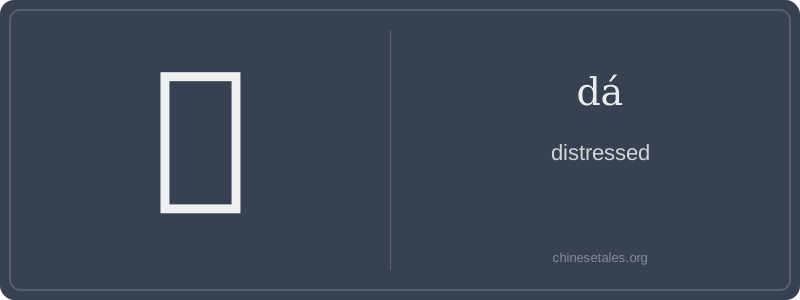
Carved onto late Shang oracle bones, the earliest form of 怛 wasn’t even this character — it was a variant of 旦 (dàn, ‘dawn’), showing the sun rising over a horizon line. But scribes began adding 心 (later simplified to 忄) beneath to distinguish a new meaning: not the light of day, but the *heart’s reaction* to sudden light — the startle reflex when dawn breaks unexpectedly in grief or danger. Over centuries, the top evolved into 旦 (with its horizontal stroke and ‘sun’ dot), while the left radical standardized into 忄 — eight strokes total: three for the heart-radical, five for the ‘dawn’ component. The shape itself is a visual paradox: light above, trembling heart below.
This duality shaped its meaning: in the Zuo Zhuan, 怛 appears in ‘怛悼’ (dá dào), describing Duke Ling’s pallor upon hearing of his son’s betrayal — not rage, but profound, silent dismay. Later, Buddhist translators adopted 怛 in Sanskrit loanword transcriptions like ‘怛侄他’ (dá zhí tuō, a dhāraṇī syllable), lending it sacred weight. Its rarity today isn’t decline — it’s preservation: 怛 survived as a linguistic relic, unchanged in emotional precision for over 2,500 years, still carrying that original shiver between light and loss.
Imagine you’re reading an ancient Buddhist sutra at midnight, candle flickering, and you come across the phrase ‘怛怖’ — your breath catches. That little word isn’t just ‘scared’; it’s the sharp, visceral jolt of dread that tightens your throat when you realize something irreversible has happened. 怛 (dá) doesn’t mean mild worry or everyday stress — it’s deep, somatic distress: the trembling hands before bad news, the hollow silence after a loss. It’s rare in speech, almost poetic or literary, and nearly always appears in fixed compounds like 怛然 (dá rán) or 惊怛 (jīng dá), never alone.
Grammatically, 怛 functions almost exclusively as a morpheme inside two-character words — you’ll never say ‘我怛’ like ‘I’m distressed’. Instead, it pairs with adverbs (怛然), verbs (惊怛), or nouns (怛怖) to intensify emotional gravity. Learners often misread it as ‘dàn’ (like 淡) or confuse it with 达 (dá, ‘to reach’) — but 怛 has no connection to achievement or clarity; it’s all about internal rupture. Its radical 忄 (heart-mind) anchors it firmly in affective experience, not action.
Culturally, 怛 carries echoes of classical restraint: unlike modern expressive words like 害怕 or 担心, 怛 implies a dignified, almost stoic suffering — the kind you’d find in Tang dynasty elegies or Buddhist texts describing the shock of impermanence. It’s so rare in daily life that many native speakers only recognize it from calligraphy or scripture. Don’t force it into casual conversation — use it like a vintage inkstone: precious, precise, and meant for moments that demand reverence.