怚
Character Story & Explanation
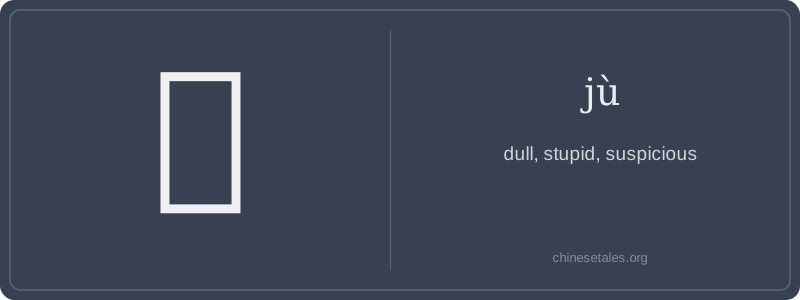
The earliest known form of 怚 appears in Han dynasty bamboo slips, not oracle bones — and it’s a masterclass in semantic fusion. Its left radical 忄 (heart-mind) anchors the emotional-cognitive domain, while the right component 居 (jū, 'to dwell, reside') was borrowed for sound *and* meaning: just as a person who 'dwells' too long in one thought becomes mentally inert, so too does the character suggest cognitive stagnation — mind 'lodged' in place, unable to move forward or adapt. Over centuries, the seal script simplified the 居 component, and clerical script smoothed its curves into today’s clean, slightly heavy structure.
This duality — dwelling + mind — crystallized in early medical and philosophical texts. The Treatise on Cold Damage (Shāng Hán Lùn) describes patients with '怚而少思' (jù ér shǎo sī, 'dull and lacking mental clarity'), linking cognitive slowness to blocked qi flow. Later, in the Book of Sworn Allegiance (a Ming-era moral anthology), 怚 appears in warnings against '怚疑' (jù yí) — not paranoid suspicion, but the unreflective mistrust born of ignorance. Visually, the character’s balance — a light-hearted radical paired with a grounded, settled 居 — mirrors its meaning: a mind weighed down by its own inertia.
Think of 怚 like the ancient Chinese equivalent of calling someone 'a bit thick' — not cruel, but with a wry, literary sigh. It conveys dullness or sluggishness of mind (not malice), and also a low-grade, almost instinctive suspicion — the kind you feel when a stranger offers unsolicited advice. Unlike English 'stupid', which often implies permanent deficiency, 怚 carries a soft, almost sympathetic weight: it’s used for someone temporarily fogged, like after too much wine or sleepless nights.
Grammatically, 怚 is almost always an adjective — but crucially, it rarely stands alone. You’ll see it in compounds (like 怚钝) or in classical-style phrases such as '性情怚滞' (xìngqíng jù zhì, 'a sluggish temperament'). It doesn’t take degree adverbs like 很 very easily; instead, modifiers tend to be literary: 颇怚 (pō jù, 'rather dull') or 稍怚 (shāo jù, 'slightly slow-witted'). Learners mistakenly try to use it like 愚 or 笨 — but 怚 isn’t colloquial; it’s a brushstroke from a Ming dynasty essay, not a WeChat chat.
Culturally, 怚 appears most often in historical novels or critiques of scholars — never in job interviews or school reports! Its tone is gently archaic, almost poetic. A common error? Using it in spoken Mandarin: no native speaker says '他很怚' — that sounds like quoting a 17th-century magistrate. Reserve 怚 for reading classical texts or writing stylized prose — and savor its quiet, dusty elegance.