怗
Character Story & Explanation
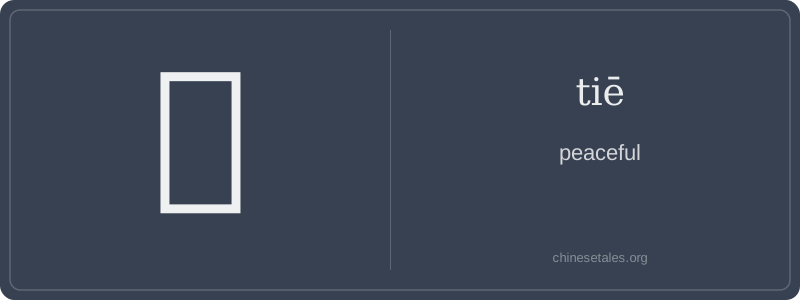
Look closely at 怗: left side is the ‘heart-mind’ radical 忄 (a variant of 心), right side is 帖 — which itself evolved from a bronze script glyph depicting a ‘damp cloth laid flat on paper to absorb ink’. That original image carried the idea of gentle, even pressure producing smooth results — no wrinkles, no gaps. Over centuries, the ‘cloth’ component simplified into the modern 帖 shape, while the 忄 emphasized the internal, affective dimension: this wasn’t just physical flattening — it was the mind’s quiet alignment with reality.
By the Tang dynasty, 怗 appeared in poetry and letters to describe emotional resolution — as in Bai Juyi’s line about sorrow ‘settling like dew on jade’ (愁思帖然). The character never meant ‘peace’ in the abstract sense; rather, it captured the moment tension dissolves into fit: a well-chosen word, a perfectly timed gesture, a decision that feels *right in the chest*. Its visual structure — heart + settled cloth — is a perfect mnemonic: peace isn’t imposed; it’s absorbed, internalized, and held gently within.
At its heart, 怗 (tiē) evokes a deep, quiet kind of peace — not the absence of noise, but the inner stillness that comes when things settle into harmony, like dust sinking in sunlit air. It’s less about political stability (that’s 安 or 稳) and more about psychological resonance: minds aligning, emotions calming, relationships smoothing over after friction. Think of it as 'emotional settling' — the gentle click of a puzzle piece finding its place.
Grammatically, 怗 is almost exclusively used in literary or poetic compounds (e.g., 妥帖, 妥贴), never alone. You’ll never say *‘tā hěn tiē’* — that would sound bizarrely incomplete to a native speaker. It appears as the second character in disyllabic adjectives, always paired with 妥 (tuǒ), forming 妥帖 (tuǒ tiē), meaning ‘just right’, ‘exquisitely appropriate’, or ‘thoughtfully settled’. Its function is deeply relational: it modifies how an action fits a context — not the action itself.
Culturally, 怗 reveals Chinese aesthetics valuing subtle congruence over overt correctness. Learners often mistakenly treat it like 安 (ān, ‘safe’) or 贴 (tiē, ‘to stick’) — both sound identical but carry completely different imagery. Worse, some try to use 怗 independently, missing that it’s a ‘half-character’: it only breathes fully when yoked with 妥. Its power lies in partnership — a quiet reminder that in Chinese thought, harmony isn’t solitary; it’s co-created.