怔
Character Story & Explanation
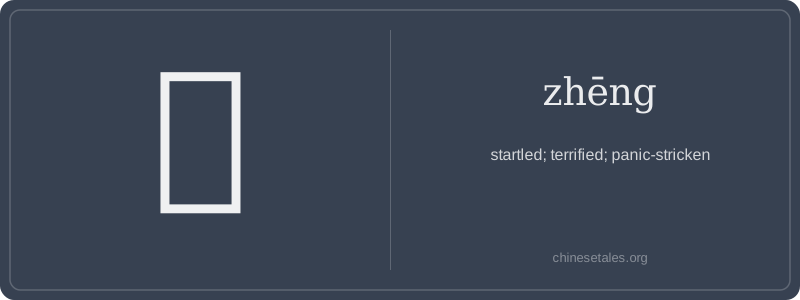
Oracle bone inscriptions show no direct precursor to 怔, but its modern form crystallized during the Han dynasty. Visually, it’s a masterclass in semantic economy: the left radical 忄 ('heart/mind') anchors it in emotion, while the right component 正 (zhèng, 'upright, correct') is key. Early seal script shows 正 with clean, balanced strokes — a figure standing straight and centered. Over centuries, scribes simplified its top stroke into a horizontal line and merged its lower elements, yielding today’s compact 8-stroke form. Crucially, 正 here isn’t about moral 'correctness' — it’s about sudden *alignment*: the mind snapping upright, rigid, and unyielding in shock.
This visual logic shaped its meaning: the heart-mind (忄) forced into rigid, upright stillness (正) by an external jolt. By the Tang dynasty, 怔 appeared in poetry describing monks startled from meditation or lovers frozen mid-confession. Its earliest recorded use is in the Song-era *Taiping Guangji*, where a ghostly apparition makes a scholar '怔然不能语' — 'stood rigid, unable to speak.' Even today, the character preserves that ancient sense of being psychically 'over-aligned' — so stunned your inner compass locks true north and won’t budge.
Think of 怔 (zhēng) as the Chinese equivalent of that split-second freeze when someone jumps out and yells 'BOO!' — not full-blown fear like 恐 (kǒng), but a sharp, breath-catching jolt of startled awareness. It’s deeply psychological: the character captures that suspended moment *between* stimulus and reaction — eyes wide, muscles locked, thought momentarily blank. You’ll almost never see it alone; it’s nearly always in reduplicated form 怔怔 (zhēng zhēng), describing a dazed, vacant stare after shock or confusion.
Grammatically, 怔 is strictly descriptive — it modifies states, not actions. You say 他怔住了 (tā zhēng zhù le) — 'He froze in shock' — where 怔住 functions like a verb phrase meaning 'to be stunned into immobility.' But beware: it’s *not* used for general anxiety or nervousness (that’s 紧张 jǐnzhāng) or for long-term fear (that’s 害怕 hàipà). Also, don’t confuse it with 蒸 (zhēng, 'to steam') — same sound, totally unrelated. And while 怔 *can* be pronounced zhèng in rare literary compounds (e.g., 怔忡 zhèng chōng, 'anxious palpitations'), zhēng is the only pronunciation you’ll need for everyday use.
Culturally, 怔 reflects a very Chinese sensitivity to sudden emotional disruption — especially in social contexts. In classical texts like The Dream of the Red Chamber, characters often 怔住 upon hearing unexpected news, revealing inner vulnerability beneath polished composure. Learners frequently misapply it as a synonym for 'surprised' (惊讶 jīngyà), but 怔 implies deeper physiological suspension — less 'Oh!' and more '…?'