怏
Character Story & Explanation
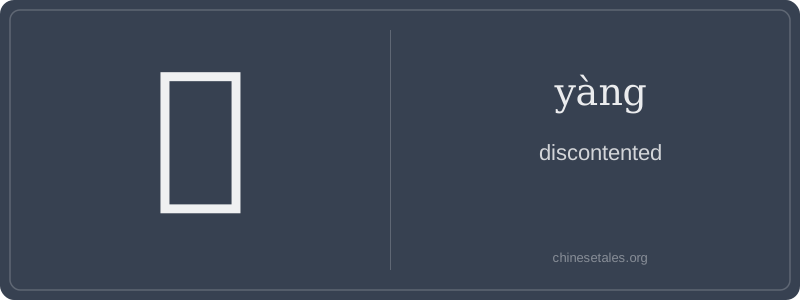
The earliest form of 怏 appears in Warring States bamboo slips, where it combined 心 (heart) on the left and 央 (yāng, ‘center’ or ‘to plead’) on the right — not the modern 王+冂 shape, but a more fluid script showing a heart cradling a figure in distress at the center. Over centuries, 心 evolved into the simplified 忄 radical (three dots + vertical stroke), while 央 gradually stylized: its top dot merged, the central ‘person’ (亠+冂) condensed, and the lower strokes smoothed — resulting in today’s clean, compact 8-stroke form. Visually, it’s a heart holding something unresolved at its core — a brilliant visual metaphor for inner discontent.
This semantic logic held firm across millennia: in the Book of Rites, 怏 describes a minister’s suppressed dismay at unjust royal decrees; in Tang poetry, it paints the silent frustration of exiled scholars. Unlike modern synonyms like 不满 (bù mǎn), 怏 implies refined sensitivity — not petulance, but the quiet ache of a cultivated person whose values have been slighted. Its persistence in literary Chinese, despite fading from speech, reveals how deeply Chinese culture honors the dignity of restrained emotion.
Think of 怏 (yàng) as the quiet frown in a room full of smiles — it’s not rage or sorrow, but that low, simmering dissatisfaction you feel when your coffee is lukewarm *again*, or when someone mispronounces your name for the third time. Its core meaning — 'discontented', 'dissatisfied', 'sullen' — carries a distinctly literary, almost classical weight; you won’t hear it in casual WeChat chats, but you’ll find it in essays, historical novels, and formal critiques. It’s an adjective that *requires* the 忄 (heart-mind) radical — this isn’t surface annoyance; it’s an internal, emotional state rooted in expectation unmet.
Grammatically, 怏 most often appears in fixed two-character compounds like 怏怏 (yàng yàng) — reduplicated for emphasis — or as the second character in phrases like 不怏 (bù yàng), though the latter is archaic. Crucially, it rarely stands alone: you wouldn’t say *‘Tā hěn yàng’* (He is very yàng); instead, you’d say *‘Tā yàng yàng bù lè’* (He sullenly refuses to be cheerful). Learners often mistakenly treat it like common adjectives (e.g., 好, 高), but 怏 resists that — it’s stubbornly poetic, almost allergic to colloquial simplicity.
Culturally, 怏 evokes Confucian restraint: it’s the feeling you suppress rather than vent. In classical texts, it signals moral unease — not just ‘I don’t like this’, but ‘This violates my sense of right order’. A common pitfall? Confusing it with 易 (yì, ‘easy’) or 样 (yàng, ‘style’) because of the shared sound — but those have no heart-radical, and carry zero emotional charge. 怏 doesn’t shout; it tightens the jaw and looks away.