怍
Character Story & Explanation
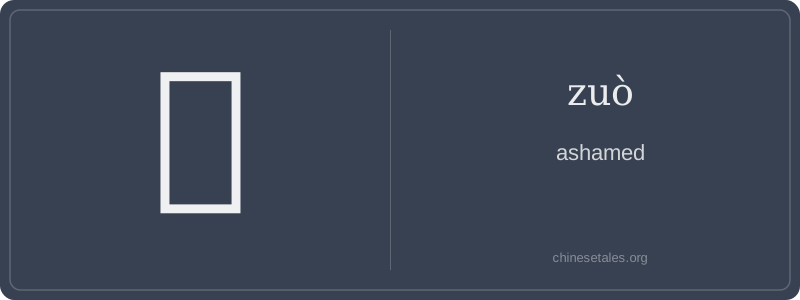
Oracle bone inscriptions show no direct precursor to 怍, but its earliest form appears in Warring States bamboo texts as a variant of 慙 (cán), built around 心 (heart/mind) and 昨 (zuó, 'yesterday') — suggesting shame rooted in reflection on past actions. By Han dynasty seal script, the left side solidified into 忄 (the 'heart' radical, indicating emotion), while the right evolved from 昨 to 乍 (zhà), likely via phonetic borrowing: 乍 meant 'suddenly' or 'abruptly', evoking the jolt of sudden self-awareness. Stroke by stroke, it simplified: the top horizontal of 乍 became the dot-and-hook, the vertical stroke stabilized, and the final捺 (nà) sweep anchored the feeling — eight strokes total, mirroring the compact intensity of a flinch.
This visual shift from 昨 to 乍 wasn’t arbitrary: 'sudden realization' + 'heart' = the visceral, immediate pang of shame. In classical texts like the Mencius, 怍 appears in phrases like '中心不怍' (zhōng xīn bù zuò, 'the heart is unashamed'), framing moral integrity as freedom from this inner tremor. Later poets used it to contrast outer composure with inner disquiet — a hallmark of literati self-examination. Its rarity today isn’t decline, but preservation: it’s kept alive precisely because it names a specific, culturally prized kind of conscience — not guilt imposed, but felt.
Think of 怍 (zuò) as the quiet, internal wince — not loud guilt or public shame, but that private, gut-level cringe when you realize you’ve messed up in a way that violates your own standards or others’ quiet expectations. It’s deeply subjective and introspective: you feel 怍 *because you know better*, not because someone scolded you. Unlike common words like 害羞 (hài xiū, 'shy') or 惭愧 (cán kuì, 'remorse'), 怍 rarely stands alone; it almost always appears in fixed literary compounds like 惭怍 (cán zuò) or 愧怍 (kuì zuò), where it intensifies the sense of moral discomfort — like adding 'deeply' or 'to the bone' to 'ashamed'.
Grammatically, 怍 is never used as a verb ('to shame') or adjective on its own — no 'I am 怍' or 'that was 怍'. It only functions within those classical two-character terms, often following verbs like 感到 (gǎn dào, 'feel') or appearing after conjunctions like 而 (ér, 'and/while'). Learners sometimes misread it as 做 (zuò, 'to do') due to identical pinyin and proximity in writing — a dangerous mix-up: saying '我感到做' sounds like 'I feel to-do', not 'I feel ashamed'! Also, don’t confuse it with 祚 (zuò, 'divine blessing') — same sound, opposite emotional polarity.
Culturally, 怍 carries Confucian weight: it reflects the ideal of self-cultivation — shame arising not from fear of punishment, but from failing one’s inner moral compass. You’ll find it in essays, formal speeches, or reflective prose, but almost never in casual WeChat chats. Overusing it sounds stiff or archaic; underusing it misses a subtle layer of ethical nuance native speakers intuitively grasp. It’s the difference between apologizing for inconvenience versus apologizing for betraying trust.