怊
Character Story & Explanation
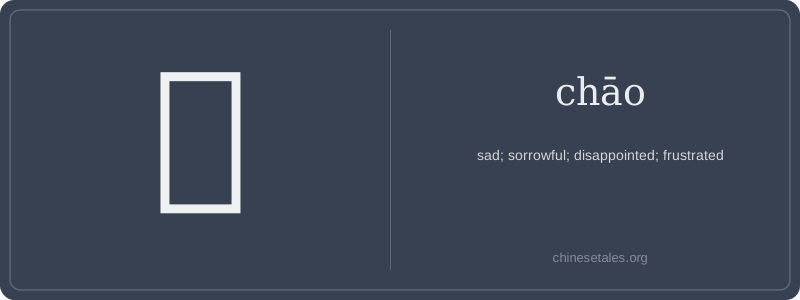
Trace 怊 back to its earliest forms, and you’ll find no oracle bone script — it’s a later creation, first appearing in seal script (c. 3rd century BCE). Visually, it’s a masterclass in semantic fusion: the left side 忄 (xīn) — the ‘heart-mind’ radical — signals emotional content, while the right side 刂 (dāo, ‘knife’) + 少 (shǎo, ‘few, lacking’) merges into the phonetic-semantic component 召 (zhào), which here serves primarily as a sound clue (chāo) but subtly reinforces absence: 少 implies diminishment, and 刀 hints at a cutting-away — not violence, but the quiet severing of hope. Over centuries, strokes simplified: the top of 召 became 丿, the lower part streamlined into 刂, yielding today’s clean, compact 8-stroke form.
This visual logic mirrors its meaning evolution: from early texts like the *Chu Ci* (Songs of Chu), 怊 described the specific sorrow of parting from a worthy person or ideal — not general sadness, but the *frustrated yearning* of something essential gone missing. By the Tang dynasty, poets like Li Bai used 怊 in compound 怊怅 to evoke existential unease — the heart ‘cut short’ of fulfillment. Its rarity in modern speech doesn’t diminish its power; rather, it preserves 怊 as an emotional scalpel — precise, rare, and reserved for moments when ordinary words fail.
At its core, 怊 (chāo) isn’t just ‘sad’ — it’s the quiet, inward ache of dashed expectation: the sigh after a rejected proposal, the hollow pause when a long-awaited letter never arrives. It carries emotional weight without melodrama — think less 'wailing' and more 'a knot in the chest that won’t loosen'. Unlike common words like 悲伤 (bēishāng) or 难过 (nánguò), 怊 is literary, almost poetic; you’ll rarely hear it in casual speech, but you’ll find it in classical poetry and refined prose where emotional precision matters.
Grammatically, 怊 functions almost exclusively as a stative verb or adjective — but crucially, it *requires* a subject with agency and introspection. You’d say ‘他怅然若失’ (tā chàngrán ruò shī), not ‘他怊’. In fact, 怊 almost never stands alone: it appears in fixed compounds like 怊怅 (chāo chàng) or paired with verbs (e.g., 怊然凝望 — chāo rán níng wàng: ‘gazed sorrowfully’). Learners often mistakenly use it like a standalone adjective ('*这个消息很怊'), but native speakers would instantly flag that as unnatural — it’s a character that *demands context*, not isolation.
Culturally, 怊 reflects a deep Chinese aesthetic valuing restrained, internalized emotion — especially the melancholy of unfulfilled potential or gentle disillusionment. It’s the feeling of standing at a riverbank watching time flow past, not the storm of grief. Mistake it for 惆 (chóu) or 怅 (chàng), and you’ll miss the nuance: those suggest lingering worry or vague disappointment, while 怊 evokes a sharper, more personal sting of loss — like realizing your ideal has quietly slipped away, not with a bang, but a breath.