忿
Character Story & Explanation
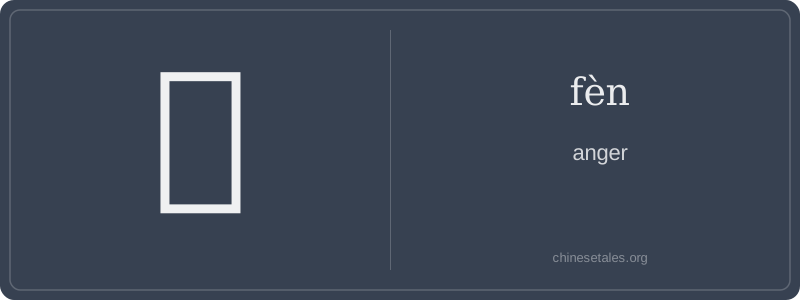
Oracle bone inscriptions show no direct precursor to 忿, but its earliest seal script form (c. 3rd c. BCE) already reveals its anatomy: the left side was originally 分 (fēn, ‘to divide’ or ‘to separate’), and the right side was 心 (xīn, ‘heart/mind’). In bronze script, 分 appeared with clear knife-like strokes cutting across a pair of lines — symbolizing division, rupture, or imbalance. Over centuries, the 分 component simplified into the modern top-left shape (a horizontal stroke, then two diagonal strokes resembling a broken ‘eight’), while 心 retained its three-dot-and-hook base. By the Han dynasty, the character had stabilized into its current 8-stroke form — a visual metaphor: a heart torn apart by division.
This ‘divided heart’ imagery became the philosophical anchor for 忿: not raw rage, but the psychological fracture caused by unfair treatment or moral violation. Mencius (4th c. BCE) used 忿 in discussions of righteous indignation — anger that arises only when virtue is thwarted. Later, in Tang poetry, 忿 appears in lines describing loyal ministers ‘心怀忠忿’ (xīn huái zhōng fèn, ‘holding loyal indignation’), linking it to civic duty. Even today, its shape whispers tension — a heart split open not by violence, but by injustice.
At its core, 忿 (fèn) isn’t just ‘anger’ — it’s the kind of white-hot, suppressed fury that simmers beneath the surface: indignation mixed with resentment, often directed at injustice or betrayal. Think less ‘I’m mad!’ and more ‘How *dare* they?’ — a morally charged, inwardly churning anger. It rarely appears alone; you’ll almost always find it in compounds like 忿怒 or 忿恨, never as a standalone verb like 生气 (shēngqì) or 发火 (fāhuǒ). It’s literary, formal, and emotionally heavy — you’d use it in writing, classical allusions, or solemn speech, not texting your friend about bad coffee.
Grammatically, 忿 functions exclusively as a noun or adjective within compound words — never as a verb, never in isolation, and never in casual speech. You won’t say ‘我忿’ (wǒ fèn); instead, you’ll say ‘他面露忿色’ (tā miàn lù fèn sè, ‘His face showed signs of resentment’) or ‘心怀忿懑’ (xīn huái fèn mèn, ‘harboring pent-up indignation’). Learners often mistakenly treat it like a verb or overuse it in spoken contexts — a red flag to native ears. Its tone (fèn, fourth tone) also rhymes with ‘fèn’ in ‘fèn qì’ (resentful energy), subtly reinforcing its emotional weight.
Culturally, 忿 carries Confucian gravity: it implies anger rooted in violated principle — not pettiness. The *Analects* warns against acting on such feelings without reflection (‘忿思难’, fèn sī nàn — ‘When angry, think of the difficulties’). Modern usage is rare outside formal writing or set phrases, making it a subtle marker of linguistic sophistication — or an easy trap for overeager learners who swap it in for common anger words.