忻
Character Story & Explanation
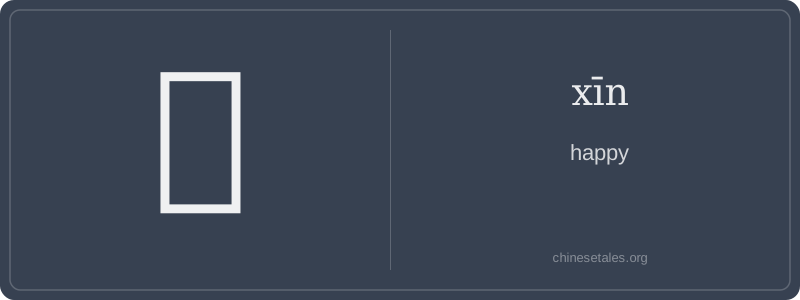
忻 began life over 2,300 years ago as a variant of 欣 in bronze inscriptions, where it appeared as ⺗ (a heart-like radical) + 斤 (jīn, 'axe' — but here acting phonetically, not semantically). In early seal script, the left side solidified into 忄 (the 'heart/mind' radical), while the right evolved from 斤 into a stylized form that retained its sound but lost its tool-like meaning — think of 斤 becoming a graceful, upward-sweeping flourish, like a heart lifting at the tip of a brushstroke. By the Han dynasty, the modern shape was set: three delicate strokes on the left (representing heartbeat and emotion), four confident ones on the right (carrying the xīn sound and buoyant feeling).
This visual lift mirrors its semantic journey: from classical texts like the Zuo Zhuan, where 忻 described the ruler’s serene satisfaction upon hearing loyal counsel, to Tang poetry where it softened into intimate, personal joy — always implying emotional resonance rather than external cause. Its rarity today isn’t decline, but refinement: like preserving a rare porcelain glaze, 忻 survives not in everyday chatter, but in names, calligraphy, and moments where language must shimmer with quiet sincerity.
忻 (xīn) is a quietly radiant word — not the loud, bouncing joy of 喜 (xǐ), but the warm, inward glow of quiet delight: a soft smile when you hear good news, the calm relief after worry lifts, or the subtle uplift of being truly welcomed. It’s elegant, literary, and emotionally precise — like finding the perfect word in English that’s been hiding just out of reach. Native speakers use it mostly in written contexts: formal letters, poetry, historical novels, or names (especially given names for girls). You’ll almost never hear it in casual speech — saying ‘I’m 忻’ sounds like quoting a Tang dynasty poem over tea.
Grammatically, 忻 functions as an adjective or verb, but unlike common happiness words, it rarely stands alone. It prefers company: 忻然 (xīn rán, 'gladly'), 忻慰 (xīn wèi, 'deeply comforted'), or paired with verbs like 忻然接受 (xīn rán jiē shòu, 'accept gladly'). Learners often mistakenly substitute it for 喜 or 高兴 in spoken sentences — but that’s like replacing 'serene' with 'happy' in a Shakespeare sonnet: technically understandable, but tonally jarring and stylistically off-key.
Culturally, 忻 carries gentle Confucian resonance — it’s the kind of joy that arises from harmony, propriety, or heartfelt recognition, not personal triumph. A classic trap? Assuming it’s interchangeable with 欣 (xīn), which looks nearly identical but means 'to admire' or 'to rejoice *in something*'. And yes — its 7 strokes include a sneaky little dot (the second stroke of 忄) that beginners often omit, turning 忻 into a ghost character no one recognizes.