忺
Character Story & Explanation
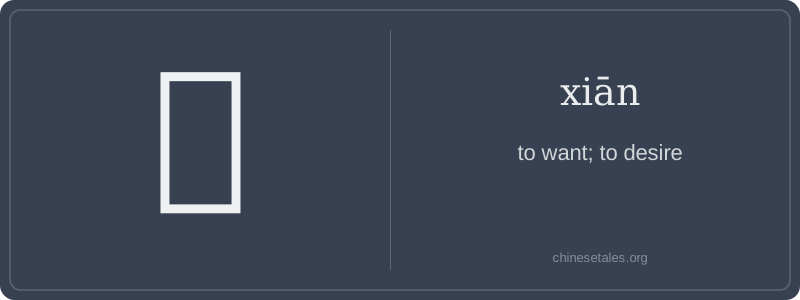
The earliest form of 忺 appears in Han dynasty clerical script — not oracle bone, but still ancient — as a compound of 忄 (heart radical) and 斤 (a sharp axe-like tool). Wait — an axe in the heart? Yes! In early usage, 斤 wasn’t just 'axe'; it represented decisive action, cutting through doubt. So 忺 literally meant 'heart cutting toward something': focused, urgent desire — not passive longing, but the heart actively cleaving a path to its object. Over centuries, the 斤 simplified, losing its blade-like flourish, and the left-hand 忄 became standardized, yielding today’s clean, compact shape.
This visceral origin shaped its classical use: Confucius praised the '忻然自得' (xīn rán zì dé) — the sage’s joyful eagerness to cultivate virtue. In the *Zuo Zhuan*, 忺 describes rulers who '忻慕仁政' (eagerly admire benevolent governance). Note the nuance: 忺 always implies alignment — desire rooted in moral aspiration or aesthetic resonance, never base appetite. Its visual austerity (just 7 strokes!) mirrors this restraint: no decorative flourishes, just heart + decisive tool — desire as disciplined intention.
Imagine you’re at a Tang dynasty poetry gathering, and a scholar sighs, '忻然忘食' — not 'happy enough to forget food', but 'so eager to grasp the Dao that hunger vanishes'. That’s 忺 (xiān): not just 'want' as in craving candy, but a deep, almost reverent yearning — like a student straining toward wisdom, or a farmer scanning the sky for rain. It’s literary, formal, and emotionally charged: less 'I want coffee' and more 'My heart 忺s for truth'.
Grammatically, 忺 is almost never used alone today. You’ll find it only in classical compounds or fixed expressions — never as a verb in modern spoken Mandarin (no '我忻你'!). It appears most often in adverbial forms like 忻然 (xīn rán, 'eagerly, joyfully') or 忻喜 (xīn xǐ, 'rejoicing with desire'). Think of it as a fossilized verb root, preserved in elegant phrases — like finding Latin 'cupere' hiding inside English 'concupiscence'.
Culturally, learners often misread 忺 as a synonym for 想 (xiǎng) or 希望 (xī wàng), but that’s a serious tone mismatch: using 忺 in casual chat sounds archaic or mock-solemn — like texting 'verily' instead of 'yes'. Also, beware: its pronunciation xiān is identical to 先 (first), but the meanings are worlds apart. This character breathes in classical texts — Li Bai used it, the *Book of Rites* invoked it — yet it’s vanished from daily speech, surviving only as a whisper in poetic diction.