忱
Character Story & Explanation
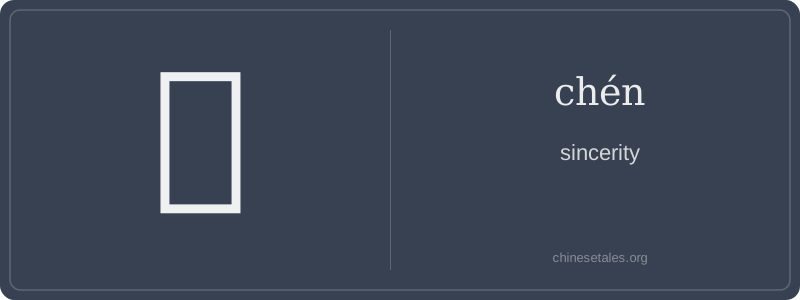
Carved into oracle bones over 3,000 years ago, the earliest ancestor of 忱 wasn’t a single character—it was two distinct signs fused over centuries: the heart radical (❤️→忄) and the ancient glyph 尧, which showed a person with an exaggerated, towering headdress—symbolizing authority, virtue, and moral elevation. In bronze inscriptions, 尧 grew more stylized: three horizontal strokes (representing tiers of virtue) crowned by a simplified head. By the small seal script era, the heart radical shifted left, the 尧 component compacted, and the modern seven-stroke form crystallized—seven strokes echoing the ‘seven virtues’ of sincerity in early Daoist texts.
This visual fusion—heart + lofty person—locked in the meaning: sincerity as cultivated nobility of spirit. In the Mencius, sincerity (often expressed via 忱’s semantic relatives like 诚) is called the ‘beginning and end of all things’—a cosmic principle rooted in authentic heart-mind alignment. Though 忱 itself rarely appears in pre-Qin texts (replaced by 诚 or 信), its emergence in Han dynasty ritual documents signals a shift: sincerity wasn’t just ethical—it was ceremonial weight, worthy of inscription on jade tablets. The character’s stillness—no dynamic radicals like 走 (to walk) or 口 (mouth)—reflects its essence: sincerity as inward, unwavering, and profoundly quiet.
At its heart, 忱 (chén) is sincerity—not the polite smile you offer a stranger, but the quiet, unshakeable authenticity that lives deep in the chest. Its radical 忄 (the 'heart' radical) anchors it firmly in emotion and inner truth, while the right-hand component 尧 (yáo) originally depicted a lofty, elevated person—suggesting sincerity as something noble, upright, and hard-won. This isn’t casual honesty; it’s the kind Confucius praised in the Analects: sincerity born of self-cultivation, not impulse.
Grammatically, 忱 almost never stands alone. It appears exclusively in formal written compounds—never in speech or casual writing—and always functions as a noun or attributive noun (e.g., 真挚的热忱). Learners often mistakenly try to use it like 心 (xīn, 'heart') or 诚 (chéng, 'honesty'), but 忱 carries no verb forms, no adverbial uses, and zero colloquial presence. You’ll find it on official commendation letters, university mission statements, or literary essays—not in WeChat messages.
Culturally, 忱 evokes a distinctly classical ideal: sincerity as moral height, not emotional transparency. A common error is over-translating it as 'enthusiasm'—but while 热忱 (rè chén) *can* mean 'enthusiasm', its core remains 'ardent sincerity'. The warmth comes from conviction, not excitement. Also beware: its near-identical twin 沈 (shěn, 'to sink') shares the same stroke count and radical—just one dot difference—but means the opposite of uplift. That dot? It’s the line between soaring sincerity and sinking despair.