忮
Character Story & Explanation
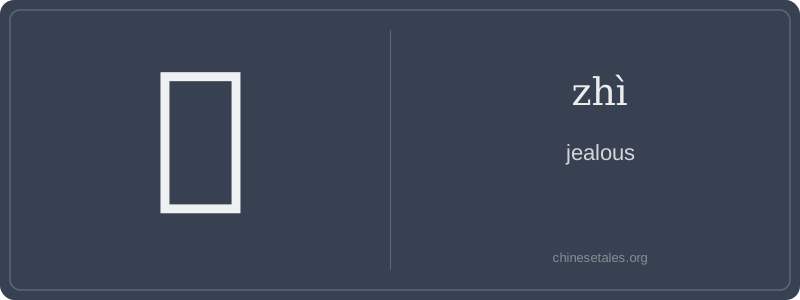
The earliest form of 忮 appears in Warring States bamboo slips as a variant of 忌 (jì, 'to fear/avoid'), sharing its right-side component — '支' (zhī), originally a hand holding a branch or tool, later simplified to '支' in 忮. The left side is 忄 (the 'heart-mind' radical), making its core meaning 'heart-fear' or 'heart-aversion'. Over time, the top of the right-hand element evolved from a clear '支' into the modern '支' shape we see today — three horizontal strokes plus a downward hook — while the left remained steadfastly 忄. Crucially, 忮 was never pictographic like 'eye' or 'heart'; it’s phono-semantic: the sound hint comes from '支' (zhī), but the tone shifted to zhì, and the meaning narrowed from general aversion to toxic envy.
This semantic narrowing happened during the Han dynasty, when scholars like Liu Xiang compiled the 'Shuo Yuan' and used 忮 to describe courtiers’ hidden grudges — not mere covetousness, but envy laced with intent to undermine. In the 'Zuo Zhuan', it appears alongside 忌 in parallel constructions, highlighting their kinship: 忌 is cautious avoidance, 忮 is active resentment. The visual pairing of 忄 + 支 subtly reinforces this: the heart radical signals inner turmoil, while '支' — whose ancient form suggests 'directing force' — implies that envy here isn’t passive; it’s directed, weaponized. That’s why classical poets chose 忮 over common synonyms: it’s envy with agency, envy with teeth.
Think of 忮 (zhì) as Chinese literature’s ‘green-eyed monster’ — Shakespeare’s famous phrase fits it perfectly, but with a sharper, more visceral edge. In Classical Chinese, 忮 doesn’t just mean ‘jealous’; it conveys *resentful envy* — the kind that simmers beneath courtesy, the quiet bitterness when someone else’s success feels like a personal slight. Unlike modern Mandarin’s more neutral jídù (嫉妒), 忮 carries moral weight: it’s one of the ‘Seven Emotions’ (qī qíng) in traditional medicine and Confucian ethics, associated with liver qi stagnation and considered spiritually corrosive.
Grammatically, 忮 is almost never used alone in speech today — it’s a literary, often compound-bound character. You’ll find it only in classical texts, formal essays, or poetic compounds like 忮恨 (zhì hèn, 'bitter resentment') or 嫉忮 (jí zhì, 'envious malice'). It’s not an adjective you’d drop into casual chat ('I’m jealous of your new phone'); instead, it appears in tightly packed, emotionally charged phrases where nuance matters — e.g., '他心怀忮意' (tā xīn huái zhì yì, 'He harbors envious ill will'). Trying to use it like a modern adjective is a classic fossilized-grammar trap.
Culturally, 忮 reveals how deeply Chinese thought links emotion to ethics and physiology. Mencius warned against nurturing 忮 because it distorts moral judgment; Sun Simiao’s Tang dynasty medical canon lists it as a cause of chronic illness. Learners often misread it as 'zhi' without tone (missing the fourth tone’s sharp, cutting quality), or confuse it with 志 (zhì, 'aspiration') — a tragic irony, since one points upward (ambition), the other inward and sour (envy). Its rarity outside classical contexts means encountering it feels like unearthing a moral relic — not just vocabulary, but a worldview in one stroke.