忭
Character Story & Explanation
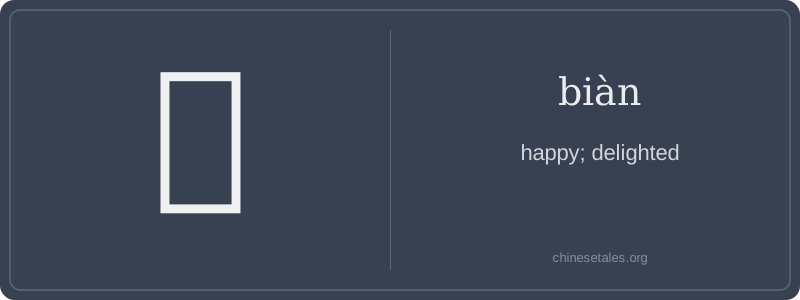
The earliest form of 忭 appears in Warring States bamboo slips as a variant of 拚 (bān), meaning 'to clap hands in joy'. Its original structure combined 心 (heart) + 卞 (biàn, an ancient pictograph of hands clapping beside a person’s head). Over time, the top part simplified into the radical 忄 (shù xīn — 'heart radical'), while 卞 evolved into the modern right-hand component — retaining its phonetic role (biàn) and hinting at expressive, embodied joy. The seven-stroke form stabilized by the Han dynasty, shedding ornate bronze-era flourishes for clean, balanced strokes.
This evolution mirrors its semantic journey: from physical exuberance (clapping) → inner emotional resonance (heart-centered delight). In the Book of Rites, 忭 appears in descriptions of ritual joy — not wild celebration, but harmonious alignment with Heaven and Earth. Later, poets like Wang Wei used 忭 to describe the quiet rapture of mountain solitude. Crucially, the character’s visual rhythm — three left-side dots (heart pulses) followed by four right-side strokes (a gesture unfolding) — subtly echoes the *pace* of deep, reflective joy: measured, intentional, and whole.
Think of 忭 (biàn) as the quiet, elegant cousin of 喜 (xǐ) — same joyful feeling, but with classical poise and a touch of restraint. It doesn’t shout 'Yay!' like 欢 (huān); it murmurs 'Ah, how pleasing' — often in literary or formal contexts, like poetry, ceremonial writing, or refined personal expression. Its core feeling is *inner, settled delight*: not giddy excitement, but deep, harmonious satisfaction — like savoring tea at dusk after resolving a long-standing worry.
Grammatically, 忭 almost never stands alone as a verb ('to be happy'). Instead, it appears in compound adjectives (e.g., 忭慰 biànwèi — 'deeply comforted') or as a rare literary predicate in classical-style sentences: '心甚忭' (xīn shèn biàn — 'the heart is deeply delighted'). Learners mistakenly try to use it like 高兴 (gāoxìng) — saying *'我很忭'* — which sounds archaic and unnatural in modern speech. Stick to compounds or formal written contexts.
Culturally, 忭 carries Confucian elegance: joy that aligns with propriety and harmony, not unbridled emotion. You’ll find it in Ming-Qing letters, imperial edicts praising loyal ministers, or Tang poetry describing serene natural beauty. A common mistake? Overusing it — or confusing it with 快 (kuài, 'fast/happy') or 易 (yì, 'easy') due to visual similarity in cursive script. Remember: 忭 is a jewel — precious, precise, and reserved for moments worthy of its grace.