忪
Character Story & Explanation
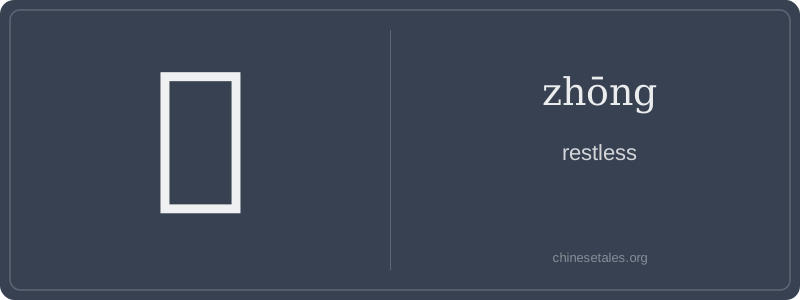
The earliest form of 忪 appears in Han dynasty bamboo slips as a variant of 悚 (sǒng, ‘to shudder’), built from 忄 (heart-mind radical) + 中 (zhōng, ‘center’ — here acting phonetically, not semantically). Visually, it’s minimalist: three dots for 忄 (a stylized heart beating erratically), then the clean, centered stroke sequence of 中 — vertical line, top horizontal, middle horizontal, bottom horizontal, enclosing the vertical. Over time, the right-hand side simplified from the full 中 to its modern compact form, losing the outer box but keeping the core ‘centered yet unsettled’ visual paradox.
This duality defines its semantic journey: 中 suggests stillness, centrality — yet paired with 忄, it flips into *disrupted* centering: the heart off-kilter *within* its own space. In the Chu Ci (Songs of Chu), 忪 appears in phrases like ‘忪怳’ describing the disoriented awe of encountering spirits — not fear, but soul-deep destabilization. By the Tang, poets like Li He used 忪惚 to evoke trance-like reverie. Its meaning never shifted outward; it stayed inward, psychological, and lyrical — a fossil of pre-modern interiority preserved in seven strokes.
Imagine a scholar in the late Tang Dynasty, pacing his moonlit courtyard at midnight — not out of anger or joy, but that low-burn, insomniac unease: heart fluttering like trapped moths, thoughts circling without landing. That’s 忪 (zhōng): restless in the quietest, most internal way — not frantic, not anxious in the modern clinical sense, but a visceral, bodily disquiet, almost physiological. It’s the feeling when your mind won’t settle *even though nothing is wrong*. This isn’t used for loud agitation (that’s 焦 or 急); 忪 lives in the hush before dawn, in poetry and classical prose.
Grammatically, 忪 is almost always an adjective — but never standalone. It appears exclusively in reduplicated form 忪怱 (zhōng cōng) or, more commonly, in fixed literary compounds like 忪怳 (zhōng huǎng) or 忪惚 (zhōng hū), where it modifies states of mental haziness or emotional tremor. You’ll never say ‘他很忪’ — that’s ungrammatical. Instead, it’s embedded: 忪怳间,她忘了自己是谁 (In a dazed, restless moment, she forgot who she was). Learners often misread it as ‘zōng’ or ‘sōng’, but the tone is firmly first-tone zhōng — like ‘chong’ in ‘chongqing’, not ‘song’.
Culturally, 忪 carries poetic weight, not conversational utility. It’s absent from spoken Mandarin and HSK because it’s archaic — a brushstroke of mood, not a tool for ordering tea. Mistaking it for everyday vocabulary leads to jarring, overly literary speech. Its power lies in restraint: one character, seven strokes, evoking centuries of quiet inner turbulence — a whisper, not a shout.