忤
Character Story & Explanation
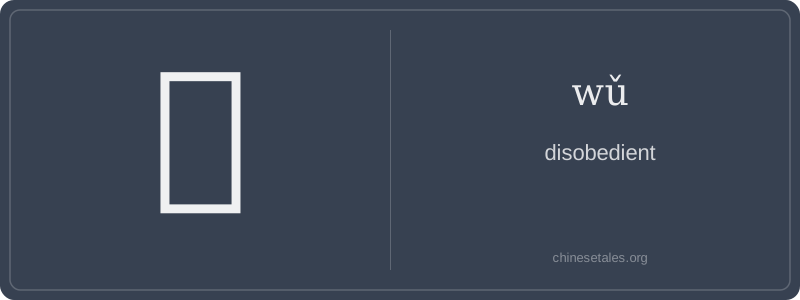
The earliest form of 忤 appears in Warring States bamboo texts, combining 忄 (the ‘heart-mind’ radical, indicating emotional/moral resonance) with 午 (wǔ, originally a pictograph of a pestle — later phonetic). But crucially, 午 also carried connotations of ‘crossing’ or ‘intersecting’ (as in 午时, the hour when the sun is at its zenith — the ‘cross-point’ of day). Over time, the left side stabilized as 忄 (replacing older variants like 心), while 午 simplified into its modern shape — seven strokes total: three dots for 忄, then four for 午 (丿、一、丨、丶).
This visual duality — heart + crossing — crystallized its meaning: an act that *crosses the heart’s proper alignment* with duty or elders. In the Book of Rites (Lǐjì), 忤 appears in passages condemning sons who ‘turn their hearts against filial conduct’ (心忤于孝). By the Tang dynasty, it had narrowed to mean ‘intentionally violating superior authority’, especially within family or court contexts — a semantic tightening that mirrors the growing codification of Confucian ethics. Its sound wǔ even echoes the word for ‘five’ (五), subtly linking to the ‘Five Relationships’ — the very framework it threatens to disrupt.
At its core, 忤 (wǔ) isn’t just ‘disobedient’ — it’s the sharp, almost visceral feeling of *deliberately crossing a line* that others hold sacred: a parent’s authority, a teacher’s instruction, or even ancestral custom. It carries moral weight and quiet tension, not childish defiance but principled (or reckless) opposition. You’ll rarely hear it in casual speech; it lives in formal writing, classical allusions, and solemn warnings — like a judge saying, ‘His words 忤逆 the emperor.’
Grammatically, 忤 is almost always transitive and appears in compound verbs: 忤逆 (wǔ nì), 忤上 (wǔ shàng), or 忤犯 (wǔ fàn). It doesn’t stand alone as a predicate adjective (you wouldn’t say ‘他很忤’); instead, it’s paired with another verb or noun to show *what* was violated — e.g., 忤父 (wǔ fù, ‘to defy one’s father’) or 忤礼 (wǔ lǐ, ‘to flout ritual propriety’). Learners often mistakenly treat it like 叛 (bàn, ‘to rebel’) or 逆 (nì, ‘to oppose’), but 忤 is more intimate, personal, and morally charged.
Culturally, 忤 reveals how deeply Confucian hierarchy shaped Chinese language: disobedience isn’t neutral — it’s a rupture in the cosmic-social order (li 理 / lǐ). Even today, calling someone 忤逆 isn’t just describing behavior — it’s invoking centuries of ethical gravity. A common mistake? Using 忤 where 拒绝 (jùjué, ‘to refuse’) or 不听 (bù tīng, ‘not listen’) would be natural and neutral — risking unintended severity or archaic tone.