忡
Character Story & Explanation
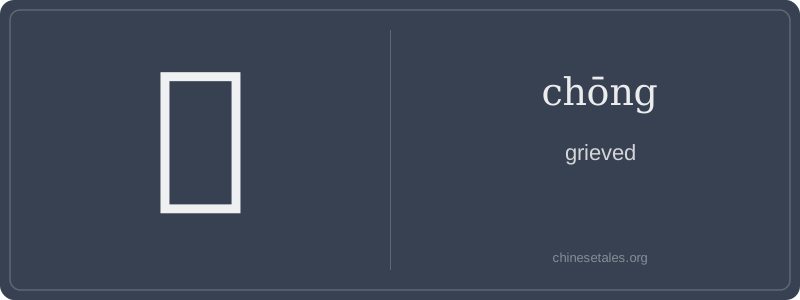
The earliest forms of 忡 appear in bronze inscriptions around 800 BCE, where its left side was the full pictograph of the heart (心), and the right was a stylized depiction of a person with bent knees and arms raised — not in joy, but in a gesture of supplication or collapse under emotional weight. Over centuries, the heart radical simplified into 忄 (the 'heart-mind' radical), while the right-hand component evolved from 虫 (chóng, 'insect') — not because sorrow is buggy, but due to phonetic borrowing: the ancient pronunciation of 虫 overlapped closely with chōng, making it a convenient sound carrier. By the Han dynasty, the character stabilized into its current 7-stroke form: three dots (忄) + four strokes (中).
This visual evolution tells a subtle truth: 忡 isn’t about outward drama, but inward tremor. The 'middle' (中) in its right half suggests centrality — the sorrow is rooted deep in the core self, not peripheral. Classical texts like the *Book of Songs* (Shījīng) use 忡 in lines like '忧心忡忡' (yōu xīn chōng chōng) — 'a heart anxious-grieved', describing a ruler’s quiet dread before calamity. Here, the doubling isn’t redundancy; it’s intensification through rhythm, mimicking the pulse of unresolved sorrow — a linguistic heartbeat that still echoes in modern literary Chinese.
At its heart, 忡 (chōng) is the quiet ache of sorrow — not loud weeping, but the tight, hollow feeling behind the ribs when grief settles in. It’s a literary, almost poetic word: you won’t hear it in casual chat or on WeChat, but you’ll find it in classical poetry, elegies, and refined modern prose where emotional restraint is valued over display. Its core vibe is *internalized distress* — think furrowed brow, clenched jaw, breath held too long. Unlike common words like 难过 (nán guò, 'feeling bad') or 悲伤 (bēi shāng, 'sorrow'), 忡 carries an archaic gravity and physiological intimacy: it literally lives in the heart-mind space.
Grammatically, 忡 almost never stands alone. It appears almost exclusively in reduplicated form 忡忡 (chōng chōng) — like a heartbeat echoing its own unease — or in classical compounds like 忧忡 (yōu chōng, 'anxious grief'). You’ll rarely see it as a verb or adjective in isolation; it’s a descriptive kernel that needs companionship to breathe. Learners often mistakenly try to use it like 愁 (chóu, 'to worry') — say, *我忡* — but that’s ungrammatical and unnatural. Instead, it’s always embedded: 心中忡忡, 忧忡难眠, etc.
Culturally, 忡 reflects a deeply Chinese aesthetic of subdued emotion — where true depth of feeling is measured not by volume, but by stillness and resonance. Confucian-influenced writing values restraint, and 忡 delivers precisely that: sorrow worn like fine silk — elegant, understated, and quietly devastating. A common learner trap is overusing it thinking it’s a ‘fancier’ synonym for sad — but native speakers reserve it for moments of solemn, reflective sorrow, often tied to loss, duty, or existential weight.