忞
Character Story & Explanation
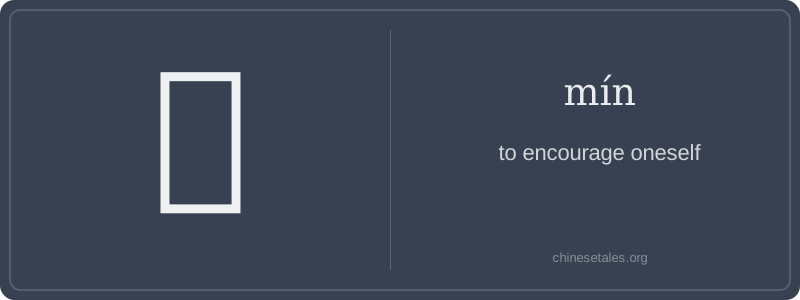
The earliest forms of 忞 appear in Warring States bamboo slips, where it was written as 心 + 民 — no simplification, just the heart radical anchoring the phonetic component 民 (people). In oracle bone script, 民 itself may have depicted a blindfolded person (with an eye pierced), symbolizing subjugated subjects — but by the time 忞 emerged, 民 had evolved into a stable phonetic signifier. The eight-stroke modern form preserves that elegant balance: the top dot and hook of 心 suggest a beating pulse, while the four strokes of 民 (horizontal, vertical, horizontal, vertical-fold) form a compact, grounded base — visually echoing how encouragement must be rooted in one’s own heart, not borrowed from outside.
Classical usage appears in texts like the Xunzi, where ‘君子自勉’ (jūnzǐ zì miǎn) describes the noble person’s habit of self-exhortation — a cornerstone of self-cultivation ethics. Over centuries, 忞 never broadened to mean ‘encourage others’; its meaning stayed tightly bound to the reflexive, moral domain. Even in Ming-Qing novels, it appears only in introspective monologues or scholarly prefaces. Its visual stillness — no action strokes like 扌 (hand) or 走 (walk) — reinforces its internal, non-performative nature: true encouragement begins not with speech, but with silent, heart-centered resolve.
At its heart, 忞 (mín) is a quiet act of inner resolve — not cheering others on, but quietly stoking your own fire. Think of it as the Chinese equivalent of whispering 'You’ve got this' to yourself before a tough task. The character radiates introspection: it’s built on the heart radical (心), signaling emotion and volition, and its right side (民) originally depicted people under heaven — suggesting collective will channeled inward. Unlike common encouragement verbs like gǔlì (鼓励), 忞 is almost exclusively reflexive and literary; you 忞 yourself, never 忞 someone else.
Grammatically, it appears mainly in classical or formal written contexts — often in parallel constructions like ‘自勉自励’ (zì miǎn zì lì) or as part of set phrases such as ‘勤学自勉’ (diligent study and self-encouragement). Learners rarely encounter it in spoken Mandarin, and attempting to use it conversationally (e.g., ‘我勉你’) sounds jarringly archaic — like quoting Confucius at a coffee shop. It’s also easily misread as mǐn (as in 敏) or wěn (a rare phonetic variant in ancient texts), but its standard modern reading is unequivocally mín.
Culturally, 忞 carries Confucian weight: self-cultivation begins with self-urging. It’s the inner nudge behind perseverance — less about motivation hacks, more about moral stamina. A common mistake is confusing it with 勉 (miǎn), which *can* mean ‘to encourage’ (including others) and shares the same pronunciation in many contexts — but 忞 is narrower, older, and strictly self-directed. Its rarity today makes it a subtle marker of literary fluency, not daily utility.