忕
Character Story & Explanation
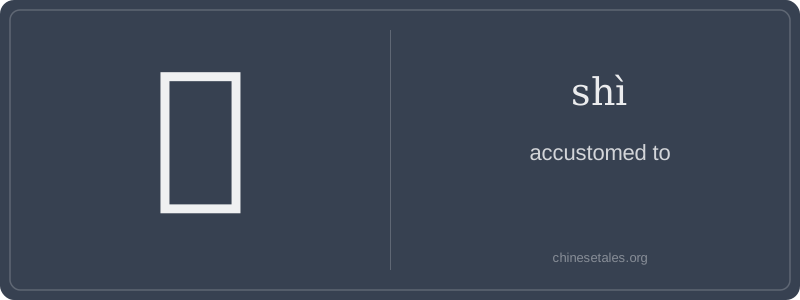
Carved onto Shang dynasty oracle bones, the earliest form of this character wasn’t 忕 at all — it was 心 (xīn, 'heart/mind') with a distinctive 'zigzag' mark above, representing repeated action or accumulation. By the Warring States period, scribes simplified the top into two horizontal strokes and added the ‘standing man’ radical (亻) to emphasize human agency — evolving into the seal script form 伇. Later, during Han dynasty standardization, the 亻 was replaced by 忄 (the 'heart-mind' radical), and the top stabilized into the two short horizontal lines we see today — visually echoing the idea of 'layer upon layer of experience settling into the heart'.
This evolution mirrors its semantic journey: from a general sense of 'repeated exposure' to a psychologically weighted term for *habituation with consequence*. In the Book of Rites (Lǐjì), it appears in the phrase 'shì ér bù wù' (accustomed to evil yet unaware), warning rulers against normalizing corruption. The shape itself — 忄 (heart) + 世 (shì, 'generation, era') — subtly reinforces this: what settles in the heart across generations becomes invisible, even dangerous. No wonder classical writers treated 忕 like a diagnostic term — not for comfort, but for vigilance.
At its heart, 忕 (shì) captures a subtle but powerful psychological state: not just 'used to' something, but *over*-accustomed — the quiet numbness that sets in after prolonged exposure, often with a faintly negative or cautionary tone. Unlike the neutral 习惯 (xíguàn), 忕 suggests a kind of emotional desensitization — think of someone who’s heard so many lies they no longer flinch, or a leader who’s grown too comfortable with power. It’s literary, formal, and rarely used in daily speech; you’ll find it mostly in classical allusions, essays, or moral critiques.
Grammatically, 忕 is almost always used as a verb in the pattern 'A 忕 B' — meaning 'A has become accustomed to B', especially where B is something potentially harmful or ethically slippery. It never stands alone like a standalone adjective ('He is 忕') — that would sound archaic or broken. Learners sometimes misread it as a noun or try to pair it with 是 or 很, but 忕 functions only as a stative verb with an implied subject-verb-object structure. For example: 'tā shì shēng huó de kùn nàn||他忕生活的困难' — not 'he is accustomed', but 'he has grown accustomed (to life’s hardships)'. The object (B) is essential.
Culturally, 忕 reflects a deep Confucian-Buddhist awareness of habit’s double edge: while routine brings stability, over-familiarity breeds complacency — even moral blindness. That’s why classical texts warn against 忕权 (shì quán, 'growing accustomed to power') or 忕恶 (shì è, 'becoming numb to evil'). Learners often skip it entirely because it’s HSK-free — but missing 忕 means missing a key lens for understanding Chinese ethical discourse: how language names the slow erosion of conscience through repetition.