忒
Character Story & Explanation
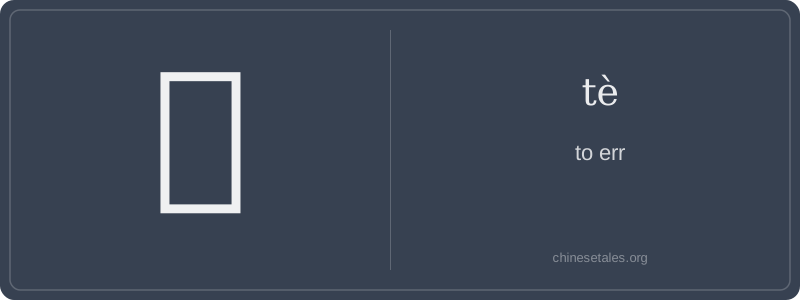
The earliest form of 忒 appears in Warring States bamboo slips as a variant of 惰 (duò, ‘laziness’) or 悖 (bèi, ‘contradiction’): a heart (心) crossed by a diagonal stroke (丿), symbolizing disruption or misalignment. Over time, the top was simplified — the original complex upper component collapsed into the single stroke 丿, while the bottom stabilized as 心 (not 忄, note!). By the Han dynasty, it had settled into its current seven-stroke shape: 丿 + 一 + 一 + 心 — visually, a heart pierced by a single, decisive slash.
This ‘pierced heart’ image anchored its meaning: not mere factual error, but moral or ontological deviation — when inner intention fails to match outer truth. In the Zhuangzi, ‘道无忒’ (dào wú tè) declares ‘the Dao contains no deviation’, affirming harmony as ethical bedrock. Later, in Song Neo-Confucian commentaries, 忒 became shorthand for any departure from heavenly principle (天理). Even today, its rarity preserves a kind of linguistic sanctity: using it signals deliberate classical resonance, like quoting scripture rather than texting.
At first glance, 忒 looks like a tiny heart (心) with a slanted stroke slashing through it — and that’s exactly the point: it’s a visual metaphor for ‘heart gone awry’. Its core meaning is ‘to err’ or ‘to deviate’, carrying a quiet moral weight, as if the heart itself has strayed from its proper path. Unlike common error-related words like 错 (cuò) or 误 (wù), 忘忒 (wàng tè) or 不忒 (bù tè) appear almost exclusively in classical or literary contexts — think Confucian texts or poetic inscriptions — where precision of virtue and alignment with Dao matter deeply.
Grammatically, 忒 rarely stands alone as a verb today; instead, it appears in fixed expressions like ‘不忒’ (bù tè, ‘without error’) or ‘差忒’ (chā tè, ‘a deviation/mistake’). Learners often misread it as tè (like 特) and assume it means ‘especially’ — a dangerous mix-up! In fact, 忒 and 特 share pronunciation but are etymologically unrelated: one means ‘error’, the other ‘special’. Also, never use 忒 in modern spoken Chinese to mean ‘very’ — that’s a dialectal homophone (tēi) used in Northeastern Mandarin, completely separate in origin and register.
Culturally, 忒 embodies an ancient Chinese preoccupation with moral fidelity: not just avoiding factual mistakes, but staying true to principle, ritual, and cosmic order. You’ll find it in the Yijing (‘no deviation in the Dao’) and the Xunzi, always paired with words like ‘正’ (zhèng, ‘correctness’) or ‘常’ (cháng, ‘constancy’). Mistaking it for a colloquial intensifier will instantly mark you as unfamiliar with classical diction — a subtle but telling linguistic boundary.