忉
Character Story & Explanation
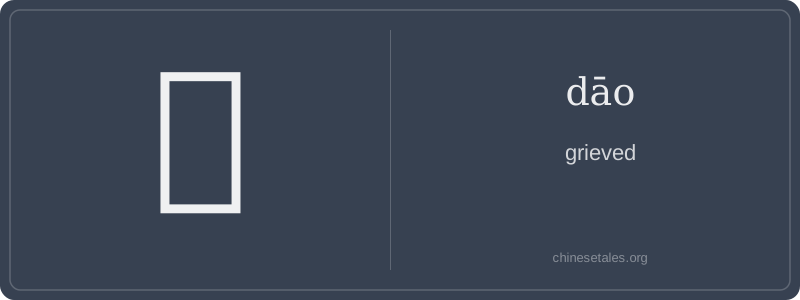
The earliest form of 忉 appears in Warring States bamboo slips as a variant of 刀 (dāo, 'knife'), but with the heart radical (忄) added beside it — not as a weapon, but as a visual metaphor: a knife piercing the heart. Oracle bone inscriptions don’t contain 忉, but its bronze script precursors show 忄 + 刀 fused into a single ideograph, where the ‘blade’ stroke cuts diagonally across the heart’s vertical line — a literal graphic wound. By Han dynasty clerical script, the shape stabilized: three strokes for 忄 (dot, flick, vertical), then two for 刀 (slanted stroke + hook), totaling five clean, decisive strokes.
This visceral image shaped its meaning: not physical pain, but the sharp, clean incision of loss — precise, internal, irreversible. In the Shuōwén Jiězì (121 CE), Xu Shen defines it as ‘grief that pierces deeply, like a blade’, citing its use in mourning odes of the Shījīng. Later, in Li Bai’s ‘Lament for Meng Haoran’, 忉 appears in the phrase ‘忉怛难言’ (dāo dá nán yán) — ‘grief too sharp to voice’. Its visual austerity — minimal strokes, no flourish — mirrors its emotional austerity: no excess, only essence.
Imagine a quiet Tang dynasty scholar, ink still wet on his scroll, staring at the moon after receiving news of his mother’s passing — not wailing, but sitting utterly still, eyes dry yet hollow, heart clenched like a fist. That silent, inward ache? That’s 忉 (dāo): not explosive sorrow, but deep, dignified grief — the kind that settles in the chest and refuses to surface. It’s rare in modern speech, almost literary, carrying classical restraint: it describes grief held close, not performed.
Grammatically, 忉 functions only as an adjective — never standalone, never verb-like — and appears almost exclusively in fixed, poetic compounds (like 忉忉 or 忉怛) or classical allusions. You won’t say ‘I am 忉’; you’ll read ‘his 忉忉之情 moved all who heard’. Learners often mistakenly treat it like common emotion words (e.g., 悲 or 伤), trying to use it predicatively — but 忉 has no colloquial life; it breathes only in verse, epitaphs, and scholarly essays. Its tone (dāo, first tone) is calm and level — mirroring its emotional quality: grief without tremor.
Culturally, 忉 embodies Confucian emotional moderation: sorrow acknowledged, not indulged. Mistaking it for everyday sadness risks sounding archaic or unintentionally theatrical. Also, watch the radical: 忄 (heart) confirms its inner-state nature — unlike 倒 (dǎo, 'to fall') which shares the ‘dāo’ sound but zero semantic kinship. This character isn’t about crying — it’s about the silence after the last tear falls.