徻
Character Story & Explanation
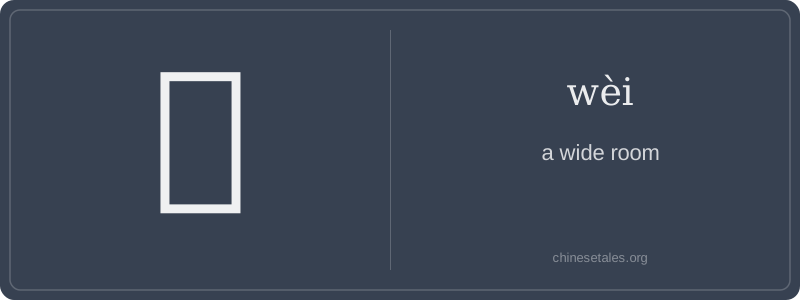
Carve this image into your mind: in early bronze inscriptions (c. 1000 BCE), 徻 began as a pictograph showing a roof (宀) over two parallel horizontal lines — not walls, but *floorboards stretching far apart*, visually shouting 'space!' Over centuries, those lines condensed into the double 一 shape beneath the roof, while the right-hand side evolved from a stylized depiction of 'to measure' (possibly linked to 尺 chǐ, 'ruler') — reinforcing the idea of deliberate, calibrated spaciousness. By the Small Seal Script era, it had settled into its current form: 宀 (roof) + 韋 (wéi, originally 'tanned leather', repurposed here for sound and connotation of 'durability' — implying a room built to last and breathe).
The meaning stayed remarkably consistent: from oracle bones describing ancestral halls in Shang rituals, to the *Book of Rites* (Lǐjì), where 徻 appears in passages about ritual architecture — '堂室必徻,以容禮器' ('Halls and chambers must be spacious, to accommodate ritual vessels'). Even in Tang poetry, poets used 徻 sparingly to evoke serene emptiness: '空庭徻然,松影橫斜' ('The courtyard lies wide and still; pine shadows slant across'). Its visual logic remains intact: roof + measured expanse = architectural dignity, not mere size.
Let’s cut to the chase: 徻 (wèi) is a ghost character — elegant, ancient, and nearly extinct. It means 'a wide, spacious room' or 'spacious chamber', evoking the hushed grandeur of a Ming-dynasty scholar’s study or a temple’s central hall. But don’t go hunting for it in modern textbooks or street signs: it’s absent from the HSK, the People’s Daily, and even most dictionaries used by native speakers today. Its vibe is literary, archaic, almost poetic — like finding a silk scroll tucked behind a subway ad.
Grammatically, 徻 functions as a noun, almost always modified by adjectives (e.g., 宏徻 — 'majestic and spacious') or embedded in classical-style compounds. You’ll never see it alone in speech — no one says 'Let’s meet in the 徻!' — but you *might* encounter it in a museum caption describing an ancestral hall: '此室宏徻,可容百人。' (This hall is vast and spacious, accommodating one hundred people.) Note: it’s never used predicatively ('The room is 徻') — that would sound like quoting a Song dynasty poem mid-conversation.
Culturally, 徻 carries quiet prestige: it implies not just physical breadth but dignified openness — think Confucian ideals of unobstructed moral clarity. Learners’ biggest mistake? Assuming it’s related to 廣 (guǎng, 'broad') or 開 (kāi, 'open'). Nope — it’s a standalone relic. Also, don’t confuse its pronunciation: wèi rhymes with 'way', not 'wee' — mispronouncing it as wēi makes natives blink, wondering if you’ve invented a new dialect.