徵
Character Story & Explanation
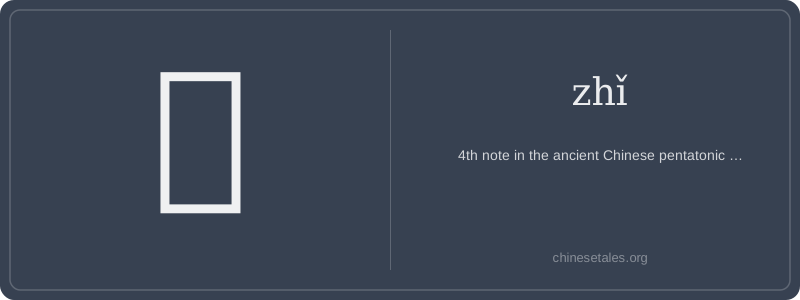
The earliest form of 徵 appears on Warring States bamboo slips, not oracle bones — and it’s a masterclass in phonetic-semantic fusion. The left side 彳 (chì) is the 'step' radical, hinting at movement or progression — fitting for a note that ‘steps’ into the fourth position in the scale. The right side was originally 廴 (yǐn, 'to extend') + 止 (zhǐ, 'to stop'), later simplified to 征 — but crucially, this wasn’t borrowed for its meaning of 'campaign'; it was chosen for its *sound*: zhǐ. Over centuries, the top of 征 evolved from ⺁ to 干, then stabilized as the modern 徵 with 15 strokes — every line calibrated for tonal precision, not conquest.
By the Han dynasty, 徵 had solidified as the fourth pitch in the five-tone system, enshrined in texts like the Lüshi Chunqiu, where each note governs an emotion, season, and organ. Interestingly, the character’s visual rhythm mirrors its musical function: the three vertical strokes in 彳 suggest steady pulse, while the balanced right side (干 + 攵) evokes the crisp articulation of a plucked qin string. In Ming-Qing literati circles, calling someone ‘a man of 徵 tone’ meant he possessed warm-hearted sincerity — proof that this character didn’t just name a note, but encoded an ethical ideal in vibration.
Think of 徵 (zhǐ) as the 'sol' of ancient Chinese music — not a modern pop song, but the resonant fifth note in the sacred pentatonic scale 五音 (wǔ yīn), alongside gōng (do), shāng (re), jué (mi), and yǔ (la). Its meaning is intensely specialized: it’s almost never used outside classical music theory, ritual texts, or historical discussions of sound cosmology. You won’t hear it in daily speech or see it on subway signs — it’s a scholar’s note, humming with Confucian harmony and Daoist resonance.
Grammatically, 徵 functions exclusively as a noun — always referring to that specific pitch. It appears in compounds like 五音之徵 or in descriptive phrases such as '徵音清越' (the zhǐ tone is clear and soaring), but never as a verb or adjective. Learners sometimes misread it as the more common character 征 (also zhēng, meaning 'to levy' or 'to march'), especially since they look similar — but 徵 has 彳 (the 'step' radical) + 征 without the 冂 enclosure, and crucially, it carries *no* military or administrative sense whatsoever. Confusing them is like mixing up 'cello' and 'census' — same syllable, utterly different worlds.
Culturally, 徵 isn’t just sound — it’s linked to summer, the heart, fire, and the south in traditional yin-yang/wu xing theory. The Yue Ji (Record of Music) says 徵 corresponds to joy and warmth; if out of balance, it causes restlessness. Modern learners rarely encounter it because Mandarin uses solfège terms like 'so' or the numbered system (5), but encountering 徵 in a Tang poem or a guqin manual is like hearing an echo from China’s sonic soul — quiet, precise, and deeply intentional.