徭
Character Story & Explanation
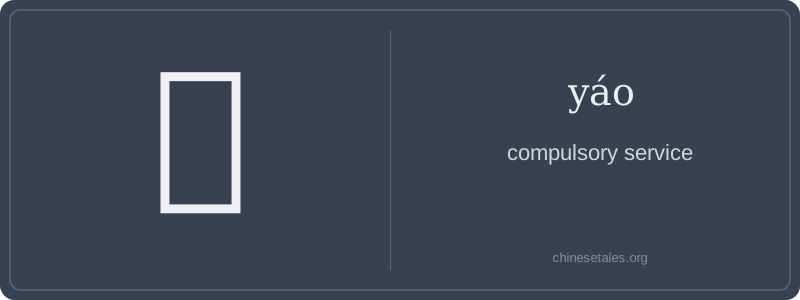
The earliest form of 徭 appears in Warring States bamboo slips — not as a pictograph, but as a phonosemantic compound already. Its left side 彳 (chì), a variant of 行 (háng, 'road'), visually suggests walking along a path — specifically, the forced march to labor assignments. The right side 爻 (yáo), borrowed for sound, originally depicted intersecting divination rods in oracle bone script, symbolizing fate or decree. Over time, 爻 simplified into the current form, while 彳 remained anchored as the movement radical — no hands, no tools, just relentless forward motion dictated by authority.
By the Han dynasty, 徭 solidified as the technical term for corvée labor in legal codes like the Juyan slips. In Sima Qian’s *Records of the Grand Historian*, 徭役 describes how Qin conscripts, working on Lishan Mausoleum, ‘starved and dropped dead beside the ramparts’. The character’s visual duality — 彳 (compelled journey) + 爻 (fated, unchangeable decree) — perfectly encodes its meaning: labor not chosen, but assigned by cosmic and bureaucratic order. Even its 13 strokes feel deliberate: 10 for the body of the character, plus 3 extra strokes in 爻 — echoing the ‘three-year rotation’ of Han-era 徭 service.
Think of 徭 (yáo) as China’s ancient equivalent of the medieval European ‘corvée’ — unpaid, state-mandated labor like building roads or hauling grain for the imperial granary. Unlike modern words for 'work' (工作 gōngzuò) or 'duty' (义务 yìwù), 徭 carries a gritty, historical weight: it’s not voluntary service, but coercive obligation — the kind that sparked peasant uprisings and filled classical texts with sighs. You’ll almost never hear it in spoken Mandarin today; it lives in history books, legal documents from imperial dynasties, and scholarly discussions of pre-modern governance.
Grammatically, 徭 functions as a noun (e.g., 服徭 fú yáo — 'to perform compulsory service') or appears in compound nouns. It rarely stands alone — you won’t say *‘I do 徭’* — instead, it’s embedded: 徭役 (yáo yì), 徭赋 (yáo fù). Learners often misread it as yóu (like 由) or confuse it with 摇 (yáo, 'to shake'), but 徭 has no motion — only burden. Its radical 彳 (chì) signals movement *along a path*, hinting at forced travel to labor sites — think conscripted peasants walking miles under guard.
Culturally, 徭 evokes the Qin and Han dynasties’ harsh levies — the very system that helped build the Great Wall and collapse empires. Modern readers sometimes misinterpret it as neutral ‘service’, missing its loaded connotation of exploitation. That’s why it’s absent from HSK: it’s not about daily communication, but about reading the subtext of Chinese history — where every stroke tells a story of power, resistance, and weary feet on dusty roads.