徬
Character Story & Explanation
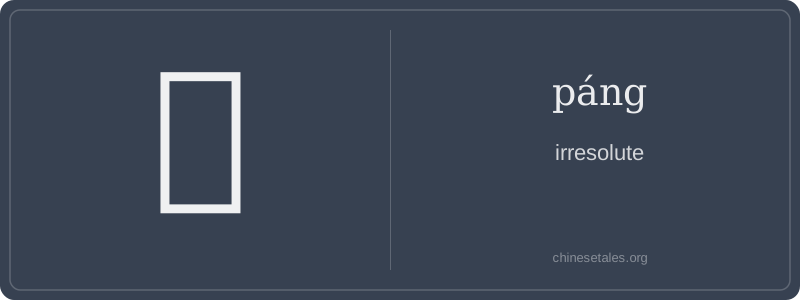
Trace 徬 back to its bronze script roots, and you’ll find no single pictograph — it’s a late-comer, born in the Warring States period as a phono-semantic compound. Its left side 彳 was already standardized as the ‘walking’ radical; the right, 傍, borrowed its sound from ‘bàng’ but twisted its meaning: 傍 originally depicted a person beside a mound (meaning ‘near’), but scribes added the ‘person’ radical (亻) to emphasize human agency — hence, ‘a person standing beside, unable to step forward or back’. Over centuries, the right side simplified from 傍 to the current form, losing the mound (阜) but keeping the ‘person’ (亻) and ‘open’ (方) — visually echoing indecision: open-ended, directionless, anthropomorphically stuck.
This semantic evolution mirrors China’s philosophical turn inward during the Zhou–Qin transition: as ritual certainty waned, language began encoding inner doubt. By the Han dynasty, 徬 appeared in the ‘Chu Ci’ commentary as a gloss for ‘heart-trembling hesitation’, and in Tang poetry, Du Fu used 徬徨 to describe scholars lost after the An Lushan Rebellion — not geographically, but morally. The character’s very structure enacts its meaning: two radicals implying motion, yet no stroke points decisively up, down, left, or right — it’s balanced, unstable, and quietly screaming.
Let’s crack 徬 (páng) like a linguistic safe: it’s not about ‘walking’ — it’s about walking *in circles*. The left radical is 彳 (chì), the ‘step-by-step’ marker that appears in characters like 徒 (tú, ‘disciple’) and 得 (dé, ‘to obtain’), always hinting at movement or process. But the right side isn’t just ‘open’ — it’s 傍 (bàng), which itself means ‘beside’ or ‘near’, and carries connotations of proximity without commitment. Together, 彳 + 傍 suggests motion *alongside* something — never arriving, never choosing, always hovering at the edge of decision. That’s why 徬 exclusively means ‘irresolute’, ‘hesitant’, or ‘wavering’ — a deeply psychological state rendered as physical limbo.
Grammatically, 徬 never stands alone. It only appears in fixed, literary compounds like 徬徨 (pánghuáng) or 徬偟 (an alternate form). You’ll never say ‘I am 徬’ — it’s always ‘I am 徬徨’. It’s adverbial or adjectival, but never verbal or nominal. Learners often misread it as ‘páng’ meaning ‘side’ (like 傍), or confuse it with 旁 (páng, ‘side’), leading to nonsensical sentences like ‘he stands 徬’ — which sounds like ‘he stands irresolutely’, an absurd image in Chinese. No — this character lives only in emotional turbulence, not spatial description.
Culturally, 徬 carries the weight of classical introspection: it’s the hesitation before fate, the pause in the Confucian path of duty, the tremor in Qu Yuan’s ‘Li Sao’. Modern usage is rare outside literature, poetry, or solemn rhetoric — you won’t hear it on WeChat. Mistake it for a common word, and you’ll sound either archaic or unintentionally poetic. Its rarity makes it a subtle badge of literacy: spotting 徬 in a text is like finding a watermark in fine paper — invisible to the untrained eye, but proof of depth.