徐
Character Story & Explanation
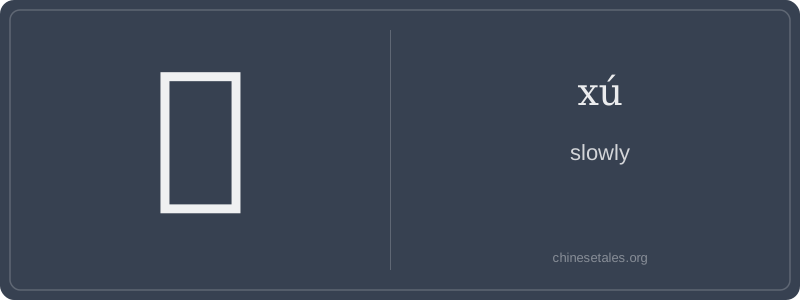
The earliest form of 徐 appears in bronze inscriptions of the Western Zhou dynasty (c. 1046–771 BCE) as a compound: left side 彳 (chì), a walking radical depicting footsteps on a road, and right side 余 (yú), originally a pictograph of a house with surplus grain — symbolizing abundance and stability. Over centuries, 余 simplified into its modern form, and the walking radical 彳 remained anchored on the left. Crucially, the ten strokes weren’t arbitrary: the three dots (丶丶丶) in the upper-right evoke falling rain or gentle motion, reinforcing the sense of unhurried descent — a visual echo of ‘slowness’ embedded in the script itself.
This character’s meaning evolved from concrete to abstract: early texts like the *Zuo Zhuan* use 徐 to describe armies advancing without haste — not retreating, but proceeding with strategic calm. By the Han dynasty, 徐 became synonymous with ‘measured progression’, appearing in phrases like 徐步 (xú bù, ‘measured step’) and later in Tang poetry describing moonlight spreading 徐徐 across a lake. Its visual composition — feet moving under a sheltering roof — quietly encodes the idea that true slowness isn’t passive; it’s grounded, intentional, and safe.
At its heart, 徐 (xú) isn’t just ‘slow’ — it’s *graceful slowness*, the kind you see in tai chi or ink-brush calligraphy: deliberate, unhurried, full of quiet control. Unlike 慢 (màn), which can imply laziness or inefficiency, 徐 carries positive weight — it suggests patience, mastery, and respect for process. In classical and literary Chinese, it’s often used to describe movement with dignity: a general advancing his troops 徐行 (xú xíng), or clouds drifting 徐徐 (xú xú). Modern usage is rarer in daily speech but remains vital in formal writing, poetry, and set phrases.
Grammatically, 徐 most commonly appears reduplicated as 徐徐 (xú xú) — an adverb meaning 'gradually, steadily, gently' — modifying verbs like 升起 (rise), 飘落 (drift down), or 展开 (unfold). It rarely stands alone as an adverb; saying *‘他徐走’ sounds unnatural. Learners sometimes overuse it trying to sound poetic, but native speakers prefer 慢慢地 or 渐渐地 in casual contexts. Also note: 徐 is almost never used predicatively (e.g., *‘他很徐’ is ungrammatical) — it modifies action, not state.
Culturally, 徐 reflects a deep-rooted Daoist and Confucian appreciation for measured rhythm — think of the I Ching’s emphasis on timing (shí 時) or the Analects’ praise for ‘the slow learner who never stops’. Mistake alert: Don’t confuse it with 許 (xǔ, ‘to permit’) — same pronunciation but totally unrelated meaning and origin. And while it’s absent from HSK, mastering 徐 unlocks nuance in literature, news headlines (e.g., 经济徐徐复苏), and even brand names (like the famous 徐家汇 district in Shanghai).