徉
Character Story & Explanation
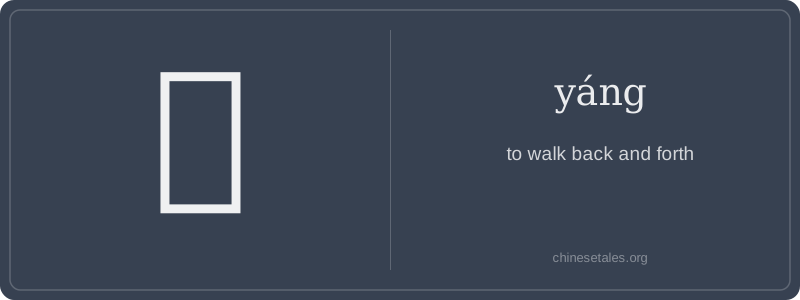
The earliest forms of 徉 appear in seal script (not oracle bone), evolving from 彳 (chì), the ‘step’ radical that anchors walking-related characters, plus 羊 (yáng) — both phonetic and semantic. Visually, 彳 on the left suggests motion; 羊 on the right isn’t about livestock — its curved horns evoke looping, circular paths. Stroke by stroke: first the two short strokes of 彳 (left foot, right foot), then the six-stroke 羊 (dot, horizontal, two slants, horizontal, vertical — mimicking horn contours). Over centuries, the top dot of 羊 merged with the final stroke, smoothing into today’s compact 9-stroke shape.
This visual loop mirrors its meaning: no start, no end — just repetition with rhythm. In the Shuō Wén Jiě Zì (121 CE), Xu Shen defined 徉 as ‘walking slowly, going and returning’, cementing its association with hesitation and reflection. By the Tang dynasty, poets like Du Fu used 徘徊 to depict existential pause — a man pacing his courtyard at dusk, torn between duty and desire. The character doesn’t just describe feet moving; it maps the mind’s restless orbit around an unanswered question.
At its heart, 徉 (yáng) is a quiet, rhythmic verb — not about speed or destination, but the gentle, contemplative act of walking back and forth: pacing, strolling without aim, wandering with presence. It evokes the image of someone lost in thought on a garden path, or a poet lingering at a riverside railing. Unlike 快走 (hurried walk) or 散步 (casual stroll), 徉 carries poetic weight and subtle melancholy — it’s rarely used in everyday speech today, but lives on in literary Chinese and set phrases like 徘徊 (pái huái), where 徉 appears as the second character.
Grammatically, 徉 never stands alone. You’ll almost never say *‘I yáng’* — it only appears fused in two-character compounds (always as the second syllable), most commonly with 徘 to form 徘徊. It’s a bound morpheme: elegant but shy, requiring a partner to speak. Learners sometimes mistakenly try to use it independently (e.g., *‘他在徉’*) — a red flag! Also, note its tone: yáng (second tone), not yǎng (third) — confusing it with 养 (to nurture) leads to comical semantic whiplash.
Culturally, 徉 embodies a deeply Chinese aesthetic of restrained movement — the ‘wandering mind made visible’. In classical poetry, 徘徊 often signals inner conflict or unresolved longing (think of Li Bai gazing at the moon, unable to step forward or turn away). Modern learners rarely encounter 徉 outside fixed expressions, so overusing it sounds archaic or theatrical. But spotting it in a Tang poem or a lyrical essay? That’s when you feel the whisper of ancient footsteps echoing down the corridor of language.