彸
Character Story & Explanation
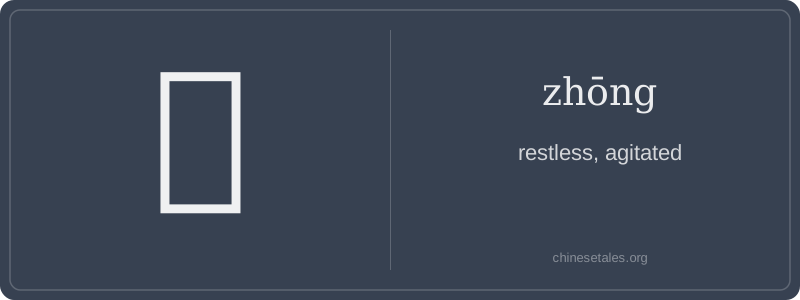
Carved onto Shang dynasty oracle bones, the earliest ancestor of 彸 wasn’t 彸 at all — it was a dynamic pictograph combining 彳 (a walking path, suggesting motion) and 重 (a heavy, layered weight, later simplified to 丷 + 一 + 丨). Imagine two feet stepping forward while a heavy stone presses down on the chest — not crushing, but *compressing*, making each step tense, unsteady. Over centuries, the ‘heavy’ component condensed: the top two dots (丷) remained, the horizontal stroke (一) anchored it, and the central vertical (丨) sharpened into a decisive spine — yielding today’s clean, tight 7-stroke form: 彶. Every stroke feels taut, like a drawn bowstring.
This visual tension directly birthed its meaning: not abstract worry, but *bodily unrest* — the kind Confucius noted in the Analects (13.18) when describing a ruler whose ‘heart is 彸, thus his steps falter’. By the Tang dynasty, poets like Li He used 彸 to describe moonlight trembling on water — not because the water moved, but because the *observer’s gaze* was unsteady. The character never became common because its specificity resisted simplification; it stayed niche, reserved for moments when language needed to register not just ‘anxious’, but the exact physical tremor before breath catches.
彸 (zhōng) is a rare, almost poetic character that pulses with nervous energy — think of a cat’s tail twitching before it pounces, or your pulse jumping at unexpected news. Its core feeling isn’t just ‘restless’ like a bored student; it’s *physiological agitation*: the flutter in your chest, the involuntary shift in posture, the body bristling before thought catches up. It carries an archaic, literary weight — you won’t hear it in daily chat, but it might flicker in classical poetry, modern essays on anxiety, or psychological commentary where precision matters.
Grammatically, 彸 functions almost exclusively as a descriptive adjective — always modifying a noun or used predicatively after 是 or 很 — never as a verb or standalone adverb. You’d say ‘彸不安’ (zhōng bù ān), not ‘彸地走’ (✗). Learners often mistakenly treat it like 忐忑 (tǎntè) and try to reduplicate it (✗彸彸), but 彸 stands alone — its power lies in its stark, single-syllable sharpness. It also resists colloquial compounds: no ‘彸哥’ or ‘彸感’, unlike more flexible characters like 烦.
Culturally, 彸 evokes a pre-modern sensibility of embodied emotion — where inner states visibly ripple outward through posture and pulse. Modern Mandarin often flattens such nuance into generic terms like 紧张 or 焦虑, but 彸 preserves a tactile, almost visceral layer. A common mistake? Confusing it with 中 (zhōng) due to identical pronunciation — but while 中 means ‘middle’ or ‘hit’, 彸 is all about *unmoored motion*. Its rarity makes it a quiet signature: when you spot it, you’re reading something deliberately refined — or someone very, very keyed up.