彴
Character Story & Explanation
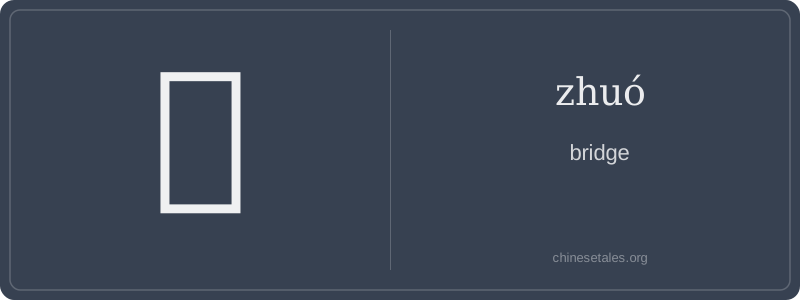
The earliest form of 彴 appears in bronze inscriptions of the late Zhou dynasty (c. 5th century BCE) as a highly stylized pictograph: two parallel horizontal lines (representing riverbanks) with a single curved stroke arching across them — unmistakably a simple, graceful bridge spanning water. Over centuries, the curve hardened into the top component 乚 (a hooked stroke), while the banks evolved into the left radical ⻊ (‘foot’/‘movement’), subtly reframing the bridge not just as structure, but as a path *for crossing*. By the Han dynasty, the right side solidified into 勺 (sháo, ‘ladle’), likely chosen for phonetic approximation (zhuó and sháo share historical sound links), though visually it now resembles a scoop — a delightful accident of script evolution.
This visual journey mirrors its semantic one: from concrete infrastructure to symbolic threshold. In the Shuō Wén Jiě Zì (121 CE), Xu Shen defined 彴 as ‘a small bridge over flowing water’, emphasizing intimacy and transience — unlike grand imperial bridges, 彴 was humble, often wooden, meant for foot traffic and quiet contemplation. Poets like Wang Wei used it to evoke impermanence: a 彴 appears in mist, then vanishes — a perfect metaphor for the Daoist ideal of effortless passage. Its shape — compact, balanced, with a gentle arc — remains a silent lesson in Chinese aesthetics: strength through subtlety, connection without intrusion.
Here’s the twist: 彴 (zhuó) isn’t just any word for ‘bridge’ — it’s a poetic, almost archaic ghost of a character. In modern Mandarin, you’ll almost never hear it spoken aloud in daily conversation; it lives instead in classical poetry, calligraphy inscriptions, and literary allusions. Its feel is elegant, quiet, and slightly melancholic — like the mist over an ancient stone bridge at dawn. Unlike the common, workhorse word 桥 (qiáo), which you’d use to ask for directions or describe a highway overpass, 彴 carries connotations of harmony, transition, and quiet connection between realms — human and nature, past and present, self and other.
Grammatically, 彴 functions exclusively as a noun and appears only in fixed, literary compounds — never alone in speech or writing. You won’t say ‘this 彴 is broken’; you’ll find it embedded in phrases like 月彴 (yuè zhuó), meaning ‘moonlit bridge’, evoking a scene from a Tang dynasty poem. It never takes aspect particles (了, 过), measure words (一座彴), or modifiers in colloquial syntax — its grammar is frozen in elegance. Learners sometimes try to substitute it for 桥 in essays, hoping to sound ‘more literary’, but native readers instantly sense the unnaturalness — like quoting Shakespeare while ordering coffee.
Culturally, 彴 reveals how Chinese values embed meaning in restraint: its rarity isn’t neglect — it’s reverence. It’s preserved not because it’s useful, but because it distills an aesthetic ideal — bridges as silent mediators, not engineering feats. A common mistake is misreading it as 拙 (zhuō, ‘clumsy’) due to similar pronunciation and visual weight; that slip turns ‘the moonlit bridge’ into ‘the clumsy moon’, a beautifully absurd error that underscores why context and etymology matter more than rote memorization.