彳
Character Story & Explanation
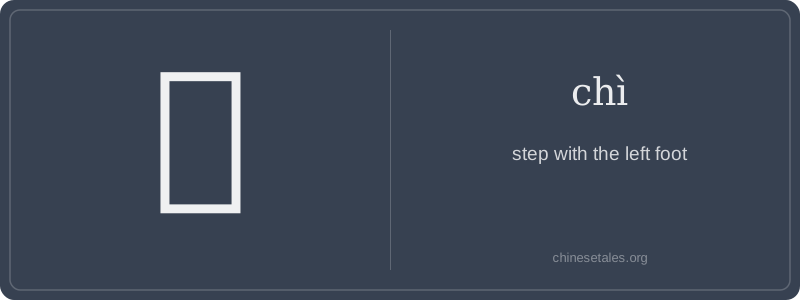
The earliest form of 彳 appears in oracle bone inscriptions as two parallel, slightly curved lines — resembling footprints or a pair of bent legs stepping forward, often paired with another sign for ‘right foot’ (亍, chū) to form 彳亍 (chìchù), meaning 'to pace back and forth'. Over time, the right-foot counterpart dropped out of independent use, and the left-foot sign simplified: the top curve became a dot-like hook, the middle stroke a descending diagonal, and the final stroke a short, firm horizontal — yielding today’s three-stroke 彳. Its shape isn’t arbitrary: each stroke maps to body mechanics — lift (dot), swing (diagonal), plant (horizontal).
In classical texts like the Book of Rites, 彳 appears repeatedly in compound characters describing ritual walking — how sages moved during ceremonies, their gait reflecting inner virtue. The pairing 彳亍 evolved into a poetic idiom for hesitation or contemplative pacing ('walking back and forth in thought'). Even Confucius referenced such measured steps as metaphors for ethical deliberation: every step was a choice. So while 彳 vanished as a word, its visual logic endured — a three-stroke blueprint for intentionality, encoded in characters that still guide how Chinese speakers conceptualize progress, ethics, and self-cultivation.
At first glance, 彳 looks like a tiny, almost invisible character — just three strokes, no standalone meaning in modern speech, and zero presence in the HSK. But don’t dismiss it! This is the quiet architect behind hundreds of high-frequency words related to movement, travel, conduct, and moral action — think 徒 (tú, 'on foot'), 得 (dé, 'to obtain'), and 德 (dé, 'virtue'). Its core idea isn’t just 'left-foot step' literally; it’s the *initiation* of motion — the first deliberate, grounded, intentional move forward. In Chinese thought, movement isn’t neutral: it carries ethical weight. To 'step' is to choose direction, responsibility, and alignment with virtue — hence why 彳 appears in 德 (moral power earned through upright conduct).
Grammatically, 彳 never stands alone — it’s always a radical, a silent partner embedded in left-side components of characters. You’ll never type or say ‘chì’ in isolation; instead, you’ll see it anchoring compound characters where motion or moral agency is implied. Learners often misread it as part of the character itself (e.g., confusing 往 wǎng 'to go' with 彳 + 主), but it’s purely structural — like the ‘walk’ component in English ‘ambulate’ or ‘perambulate’, invisible yet essential.
A common trap? Assuming 彳 is ‘just a stroke variant’ of 亻(rén, ‘person’) or 丿(piě, ‘slash’). It’s not. While 亻is a full radical meaning ‘person’, 彳 is strictly locomotive — it’s about *how* one moves, not *who*. And unlike 丿, which is a generic stroke, 彳 is a semantic unit with history and intention. Its invisibility is its power: it’s the unseen grammar of motion and morality woven into the language’s DNA.