彬
Character Story & Explanation
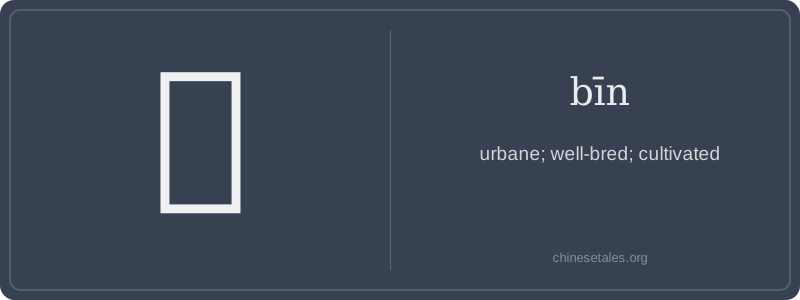
The earliest form of 彬 appears in bronze inscriptions as a combination of two elements: 文 (wén, 'culture, pattern') on the left and 彡 (shān, 'ornamental strokes, decorative lines') on the right. The radical 彡 wasn’t just decorative — in ancient times, it represented ritual body paint, ceremonial hairpins, or embroidered robes: visible marks of cultural attainment. Over centuries, the left side evolved from a full 文 into its modern simplified form, while the right retained three distinct strokes (彡) — not random flourishes, but deliberate glyphs symbolizing aesthetic refinement applied to human character.
This visual fusion — 文 + 彡 — crystallized the Confucian ideal expressed in the Analects (12.8): '質勝文則野,文勝質則史。文質彬彬,然後君子。' ('If substance dominates culture, one is rustic; if culture dominates substance, one is pedantic. Only when culture and substance are harmoniously blended — 彬彬 — does one become a true gentleman.') Here, 彬彬 isn’t ornamental — it’s the precise, dynamic equilibrium between inner authenticity and outer cultivation, captured in eleven strokes that still whisper of ritual robes and bronze-age wisdom.
At its heart, 彬 (bīn) isn’t just about being ‘polite’ — it’s the Chinese ideal of cultivated harmony: the quiet confidence of someone whose inner refinement shines *through* their manners, not *instead* of them. Think less 'stiff etiquette' and more 'effortless grace' — like a scholar-poet who bows smoothly while quoting Du Fu, or a modern executive who negotiates fiercely yet never raises their voice. This is Confucian elegance made visible: virtue (文 wén) and substance (质 zhì) in perfect balance.
Grammatically, 彬 is almost never used alone. It appears almost exclusively in the compound 彬彬 (bīn bīn), an elegant reduplicated adjective meaning 'urbane, well-bred, cultured'. You’ll hear it in formal praise ('他为人彬彬有礼' — 'He is courteous and refined') or literary descriptions ('彬彬君子' — 'a cultivated gentleman'). Learners sometimes mistakenly treat it as a standalone verb or noun — but no: it’s a fossilized literary adjective that only breathes in pairs.
Culturally, 彬彬 carries quiet weight: it implies moral depth beneath surface charm. A person can be polite (有礼貌 yǒu lǐmào) without being 彬彬 — but 彬彬 always includes sincerity, learning, and self-awareness. Western learners often overuse it in casual speech (e.g., saying '你很彬' — which sounds bizarrely truncated and archaic); reserve it for writing, speeches, or formal compliments. Also note: it’s pronounced bīn (first tone), *not* bīng — confusing it with 冰 (ice) would make your compliment sound frosty!