彧
Character Story & Explanation
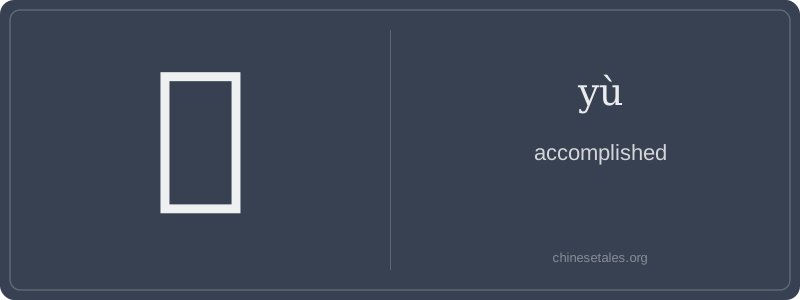
The earliest form of 彧 appears in bronze inscriptions of the late Shang and Western Zhou — not as a single pictograph, but as a composite glyph combining 王 (wáng, ‘king’) with three flowing strokes (彡) representing ritual ornamentation or radiant qi. Over centuries, the top evolved into 或 (huò, ‘or’ — here phonetic, not semantic), while the bottom stabilized as 彡, the radical signifying decorative flourish. By the Small Seal Script era, it had crystallized into today’s ten-stroke structure: the top 壬 (rén, a variant of 或) plus the ornamental 彡 — a visual metaphor for authority adorned with cultivated virtue.
This evolution mirrors its meaning shift: from ‘radiant presence of royal ritual’ in oracle bones, to ‘refined, accomplished virtue’ by the Warring States period. It appears in the *Zuo Zhuan* and *Shiji* describing ministers whose moral bearing elevated entire courts. Notably, Sima Qian uses 彧 to describe Confucius’s disciples — not their deeds, but their *aura* of learned composure. The character’s visual lightness (three delicate strokes) contrasts its semantic weight: it doesn’t shout achievement — it glows with quiet, earned distinction.
Imagine a quiet, misty library in Luoyang during the Eastern Han dynasty — not full of dusty tomes, but glowing with scholarly aura. In the center stands Cao Cao’s brilliant strategist Xun Yu (荀彧), whose name literally means ‘Xun the Accomplished’. That second character, 彧, isn’t just ‘accomplished’ in a generic sense — it evokes cultivated elegance, moral refinement, and intellectual distinction so rare it borders on luminous. It’s not an adjective you’d slap onto a resume; it’s reserved for people (or occasionally places or texts) whose excellence radiates like polished jade.
Grammatically, 彧 almost never appears alone — it’s strictly a *name character*, used exclusively in personal names (especially classical or literary ones) and very rarely in fixed literary compounds. You’ll never say ‘this project is 彧’ — that would sound bizarre, like calling a spreadsheet ‘Shakespearean’. Instead, it lives inside names: Xun Yu, Kong Yu (孔彧), or modern writers who choose it for its gravitas. Learners often mistakenly treat it as a standalone descriptive word — a classic trap, since it carries zero colloquial usage.
Culturally, 彧 whispers Confucian ideals: accomplishment not as loud success, but as inner cultivation made visible. Its radical 彡 (shān) — the ‘ornament’ radical — hints at this: refinement as aesthetic adornment of virtue. Mistake it for 易 (yì, ‘easy’) or 宇 (yǔ, ‘universe’) and you’ll accidentally call someone ‘easy’ or ‘cosmic’ instead of ‘accomplished’. And yes — it’s absent from HSK because it’s too rare for daily use, yet deeply resonant in historical and literary contexts.