彦
Character Story & Explanation
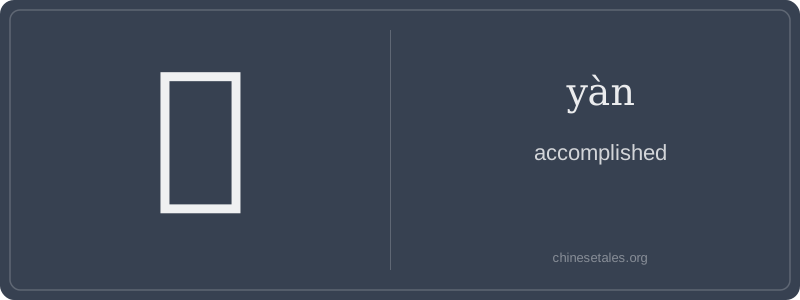
The earliest form of 彦 appears in bronze inscriptions of the Western Zhou dynasty (c. 1046–771 BCE) as a composite glyph: on top, a stylized head (彐, later evolving into the top part of 产), below it a mouth (口), and beneath that, three wavy strokes (彡) representing ornamental hair or ceremonial adornment. Over centuries, the head simplified into 产 (chǎn), the mouth fused subtly into the middle, and the three 彡 strokes remained proudly intact — preserving the idea of *visible distinction through cultivation*. By the Han dynasty, 彦 had stabilized into its modern nine-stroke shape, still radiating elegance through those three decorative strokes.
This visual logic shaped its meaning: 彦 wasn’t about raw talent, but about *refined excellence made evident* — like a scholar whose poetry, calligraphy, and conduct all harmonize into unmistakable distinction. The Shuōwén Jiězì (121 CE) defines it as ‘beautiful words and virtuous conduct’ (美士有文辭也), and it appears in the Book of Songs describing noble ministers whose wisdom and speech dazzled like embroidered robes. Even today, when a Chinese parent names their child Yàn, they’re invoking not just success — but luminous, graceful, morally grounded distinction.
‘Yàn’ (彦) isn’t just ‘accomplished’ — it’s the Confucian ideal made lexical: someone whose virtue, learning, and eloquence shine so brightly they’re *visibly distinguished*, like polished jade catching light. In classical Chinese, 彦 almost always modifies people — scholars, ministers, or paragons — never objects or abstract concepts. You’ll rarely hear it in modern spoken Mandarin; it lives in names (e.g., Wáng Yàn), formal eulogies, and literary allusions. Its tone is reverent, slightly archaic, and deeply cultural — think ‘sage-scholar’ more than ‘skilled worker’.
Grammatically, 彦 functions almost exclusively as a noun modifier (like an adjective before a noun), often in compounds such as 彦士 (yàn shì, ‘exemplary scholar’) or in fixed phrases like 俊彦 (jùn yàn, ‘outstanding talents’). It doesn’t stand alone as a predicate (*He is yàn* sounds unnatural); instead, you say 他是当代俊彦 (Tā shì dāngdài jùn yàn — ‘He is an outstanding talent of our time’). Learners mistakenly try to use it like 成功 (chénggōng, ‘successful’) — but 彦 implies moral refinement *and* intellectual brilliance, not just achievement.
Culturally, 彦 reveals how early Chinese valued visible excellence — not just competence, but cultivated grace that others could *perceive*. The radical 彡 (shān), meaning ‘ornamental strokes’, hints at this: true accomplishment must be *adorned* — expressed through speech, writing, demeanor. A common learner pitfall? Overusing it in casual contexts. Saying ‘My friend is very yàn’ would sound like praising someone with a Tang-dynasty imperial edict — charmingly absurd, utterly out of place.