彐
Character Story & Explanation
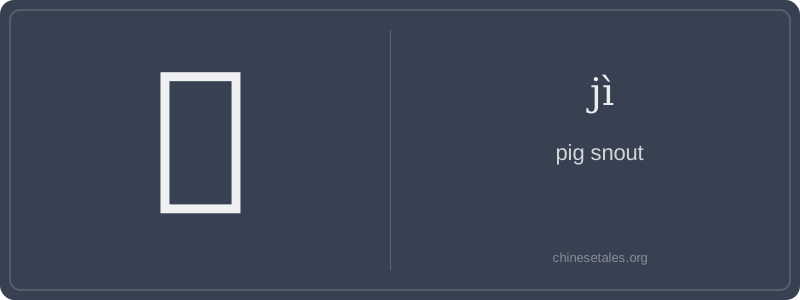
The earliest form of 彐 appears in Shang dynasty oracle bone inscriptions as a clear pictograph: three wavy or curved lines representing the fleshy, flexible, downward-curving snout of a pig — complete with nostrils suggested by small dots or short strokes. Over centuries, the curves simplified: the upper arc became a smooth horizontal stroke, the middle softened into a gentle curve, and the lower line straightened into a flat base — yielding today’s clean, minimalist three-stroke form: 乚 一. Though tiny, every stroke preserves the essence of enclosure and soft curvature — no sharp angles, all gentle embrace.
This ‘snout’ didn’t stay literal for long. By the Warring States period, 彐 had evolved into a semantic radical symbolizing ‘shelter’, ‘inward gathering’, or ‘domestic containment’ — likely because pigs were kept in enclosed pens, and their snouts were the first part to enter and root within a space. In the Shuōwén Jiězì (121 CE), Xu Shen classified it under ‘snout’ but noted its use in characters related to ‘returning’, ‘searching’, and ‘home’, cementing its metaphorical shift from anatomy to abstraction — a rare case where a body part became a philosophical glyph for belonging.
Imagine you’re sketching a cartoon pig in a Chinese calligraphy class — not the whole animal, just its snout poking out from behind a bamboo fence. That curved, three-stroke shape you draw? That’s 彐 (jì), literally ‘pig snout’. It’s not a word you’ll use in daily chat — you won’t say ‘I saw a pig snout’ — but it’s a quiet powerhouse hiding inside dozens of common characters like 家 (jiā, family), 寻 (xún, to search), and 归 (guī, to return). In those words, 彐 isn’t pronounced jì at all; it’s a silent radical, a visual anchor that once evoked the idea of ‘shelter’ or ‘enclosure’, linked to the snout’s curved, enclosing shape.
Grammatically, 彐 never stands alone as a word in modern Mandarin — no native speaker says ‘jì’ meaning ‘pig snout’ in conversation. It only appears as a component. Learners sometimes mistakenly try to pronounce it in compounds (e.g., misreading 家 as ‘jiā’ with a hidden ‘jì’ sound), but it contributes zero phonetic value there. Its role is purely semantic and structural: a three-stroke signature of containment, warmth, and domestic space — think of how a pig’s snout roots into earth, seeking home.
Culturally, this character is a fossil of ancient observation: early Chinese scribes saw profound symbolism in an animal’s most tactile, grounded feature. Modern learners often overlook it because it’s not in HSK, but skipping it means missing the logic behind why 家 (home) contains a ‘snout’ — a reminder that ‘family’ was originally imagined as a sheltered, rooted, life-sustaining space, like a pig nestled safely in its sty.