彀
Character Story & Explanation
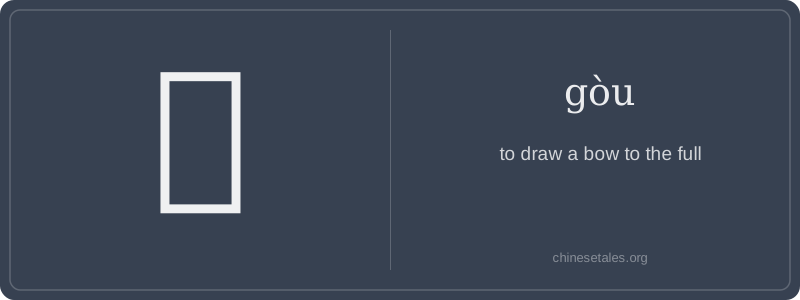
The earliest form of 彀 appears in Warring States bamboo texts, not oracle bones — and it’s a masterclass in visual logic. Its left side 弓 (gōng) is unmistakably the bow radical, drawn with three curved strokes mimicking a bent yew stave. The right side 告 (gào) isn’t arbitrary: in ancient script, 告 depicted an altar with a mouth above it — signifying ‘solemn declaration’. Combined, they showed an archer making a vow *at the moment of full draw*: a sacred alignment of body, weapon, and intent. Over centuries, 告 simplified from altar+mouth to its modern shape, while 弓 retained its elegant curve.
This fusion of ritual and mechanics endured. Mencius (3A:2) uses 彀 to describe moral cultivation: ‘The superior man draws his bow, but does not loose it — he waits for the proper target.’ Here, the physical act becomes ethical metaphor: readiness without recklessness. Even today, the character’s 13 strokes echo the 13 critical points of tension in a traditional composite bow — a detail that delighted Song dynasty calligraphers who saw calligraphy itself as ‘drawing the brush like a bow’.
At its heart, 彀 (gòu) isn’t just about pulling a bowstring — it’s about *peak tension before release*, a moment charged with intention, precision, and quiet power. In classical Chinese, this verb evokes the archer’s full-body stillness: shoulders locked, breath held, sinew taut — not yet loosing the arrow, but already commanding its trajectory. Modern usage is almost exclusively literary or rhetorical; you’ll rarely hear it in daily speech, but you’ll see it in essays, historical dramas, or political speeches to symbolize ‘reaching maximum readiness’ — like a nation ‘drawing its bow’ before decisive action.
Grammatically, 彀 functions as a transitive verb, typically followed by an object (e.g., 彀弓 ‘draw the bow’) or used in passive/figurative constructions (e.g., 弩已彀 — ‘the crossbow is drawn’). Learners often mistakenly treat it as a noun or adjective, but it never stands alone as a subject — it always implies an agent acting with focused control. It also never takes aspect particles like 了 or 过; its power lies in the *state* of being fully drawn, not the act of drawing.
Culturally, 彀 reflects the deep Confucian-Taoist reverence for *wu wei* — effortless action born of perfect preparation. The archer doesn’t strain; he aligns. That nuance is lost if translated simply as ‘to draw’. Mistaking 彀 for similar-sounding words like 够 (gòu, ‘enough’) leads to hilarious mistranslations — imagine declaring ‘my courage is enough’ when you meant ‘my resolve is drawn taut as a bow!’