弼
Character Story & Explanation
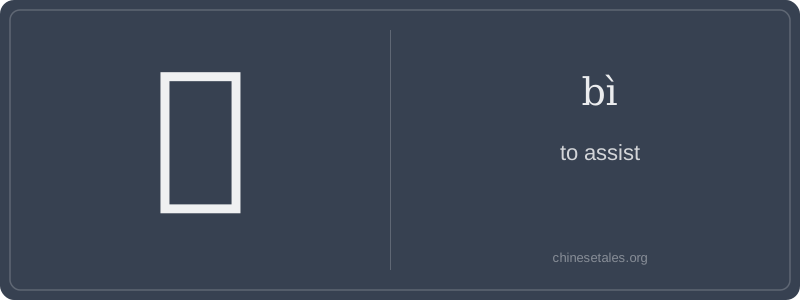
The earliest form of 弼 appears in bronze inscriptions as two 弓 (bow) radicals flanking a central element resembling ‘百’ or ‘廾’ (two hands), suggesting dual hands manipulating the limbs of a bow—precisely calibrating tension for accuracy. Over time, the left 弓 remained clear, while the right evolved into the simplified 弋-like shape seen today, and the central ‘hands’ fused into the top ‘丿’ and lower ‘一’ and ‘丨’, solidifying into the modern 12-stroke structure: 弓 + 丙 (bǐng) — though 丙 here is purely phonetic, not semantic.
By the Warring States period, 弼 appeared in texts like the *Zuo Zhuan*, describing ministers who ‘bì the ruler’—not commanding, but enabling sovereign virtue through discreet counsel and correction. Its visual duality (two bows) reinforced the idea of balanced, symmetrical support—neither dominating nor diminishing the principal. The Tang poet Du Fu later praised officials who ‘kè bì míng zhèng’ (diligently assisted enlightened governance), cementing 弼 as the gold standard for virtuous, technically skilled aid. Even today, its bow radical silently reminds us: true assistance isn’t force—it’s precision alignment.
Imagine a royal archery master in the Zhou dynasty court, not just firing arrows—but standing *beside* the king’s bow, subtly adjusting the tension of the string with both hands to ensure perfect aim. That’s 弼 (bì): not mere ‘helping’, but precise, skilled, almost invisible assistance—like a co-pilot fine-tuning flight controls. It carries weight, dignity, and quiet competence; you’d never use it for handing someone a napkin. It’s literary, formal, and nearly always paired with other verbs or nouns—not used alone.
Grammatically, 弼 functions almost exclusively as a verb in classical or elevated modern prose, often in parallel structures: ‘辅弼’ (fǔ bì), ‘匡弼’ (kuāng bì), or ‘佐弼’ (zuǒ bì). You won’t hear it in daily speech—it’s absent from HSK because it lives in policy white papers, historical dramas, and official titles like ‘弼马温’ (bì mǎ wēn)—the ‘Horse-Placating Gentleman’, Sun Wukong’s first heavenly post (a deliciously ironic title implying ‘assisting with horses’, though he was really just stablemaster). Note: it’s never transitive with ‘bāngzhù’-style objects (e.g., *‘bì tā’ is ungrammatical); it requires a formal complement like ‘bì guó’ (assist the state).
Culturally, 弼 evokes Confucian ideals of loyal, self-effacing service—assistance that strengthens authority without seeking spotlight. Learners often misread its radical 弓 (bow) as irrelevant, but it’s central: the character literally embodies ‘adjusting the bow’. Mistaking it for common helpers like 帮 or 助 leads to jarring formality errors—like saying ‘I shall bì you with your homework’ at a café. Use it only where gravity and tradition are expected.