弸
Character Story & Explanation
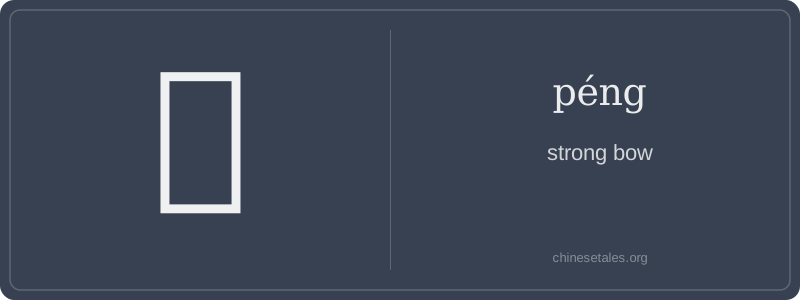
The earliest form of 弸 appears on Warring States bamboo slips as a stylized bow (弓) with three short, parallel strokes across its string — representing tautness, vibration, and the physical strain of maximum draw. Over centuries, those three strokes fused into the top component (which looks like 朋 but isn’t), while the lower 弓 radical remained unmistakably bow-shaped. By the Han dynasty, the character stabilized into its current form: two ‘moon’-like shapes (朋) stacked atop 弓 — a visual pun on resonance (‘peng’ sound echoing ‘friend’ 朋) and tension (two equal forces pulling apart).
This evolution mirrors its semantic journey: from concrete bow-tension in bronze inscriptions (e.g., ‘the king’s 弸弓 struck true’) to abstract potency in early Confucian commentaries, where 弸 describes moral fortitude that bends but never breaks — like a perfectly drawn bow. The *Zuo Zhuan* uses 弸矢 metaphorically for ‘unassailable argument’, linking archery precision to rhetorical power. Even today, calligraphers note how the balanced, symmetrical structure of 弸 visually enacts equilibrium under pressure — no stroke dominates; all bear weight equally.
Imagine a Zhou dynasty archer, muscles coiled like spring steel, drawing back a bow so powerful it hums — not with vibration, but with latent force. That’s 弸 (péng): not just ‘strong bow’, but the *essence* of taut potential, the moment before release where tension becomes authority. In classical Chinese, 弸 appears almost exclusively as a descriptive modifier — never standing alone as a noun or verb, always paired: 弸弓 (péng gōng), 弸矢 (péng shǐ). It’s poetic, rare, and deeply tactile: you *feel* the resistance in the word.
Grammatically, 弸 functions only as an adjective — and a highly literary one at that. You’ll never hear it in modern speech or HSK-level texts. It doesn’t take aspect particles (了, 过), can’t be reduplicated, and never heads a clause. Mistake it for a verb? You’ll sound like someone quoting oracle bones at a coffee shop. Its usage is strictly bound to classical compound nouns describing archery equipment or metaphorical strength — e.g., ‘the 弸 string’ implies unbreakable resolve, not literal twine.
Culturally, 弸 carries the weight of ritual precision: in ancient rites, the 弸弓 wasn’t just powerful — it was calibrated to symbolize virtue under pressure. Modern learners often misread its radical (弓) and assume it’s related to common words like 张 (zhāng, ‘to stretch’) or 强 (qiáng, ‘strong’). But 弸 isn’t about general strength — it’s about *bow-specific tensile power*, a nuance lost if translated simply as ‘strong’. And yes — its stroke count is zero in most dictionaries because it’s considered obsolete; you’ll find it only in specialized paleography references or pre-Qin bamboo texts.