弶
Character Story & Explanation
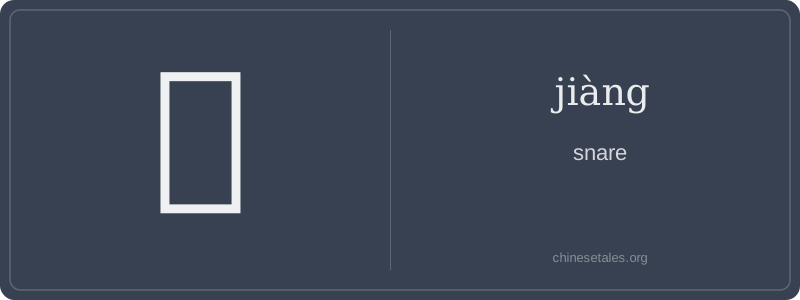
The earliest form of 弶 appears in late Warring States bamboo slips and Han dynasty texts — not oracle bones, since it’s relatively young. Visually, it’s a masterclass in semantic composition: the top radical ⺈ (the ‘knife’ or ‘cutting’ head) suggests action and sharpness; the middle component 井 (jǐng, well) is a stylized grid — echoing the woven lattice pattern of the snare; and the bottom 弓 (gōng, bow) isn’t about archery, but shape: the curved, tension-ready arc of a sprung bamboo loop. Over centuries, the well-grid simplified from a full ‘+’ inside a square to the modern 井, while 弓 retained its elegant curve — together forming a pictographic blueprint of a spring-loaded trap.
This character didn’t exist in Classical Confucian texts, but emerged in regional vernacular records by the Tang–Song transition, tied to hunting regulations and folk ecology. In Ming–Qing agricultural manuals, 弶 appears alongside terms like 罾 (zēng, lift-net) and 罟 (gǔ, gillnet), distinguishing land-based, non-lethal bird snares from aquatic gear. Lu Xun revived it deliberately in 1921 — not as antiquarian decoration, but as a symbol of lost intimacy with nature and craftsmanship. Its visual logic — grid + bow + cutting edge — remains perfectly legible today: a device designed to hold, not harm; to capture, not kill.
Think of 弶 (jiàng) not as a common word, but as a linguistic fossil — a beautifully specific term for a traditional, hand-woven snare used to trap birds or small animals, especially in rural and classical Chinese contexts. It’s not just 'trap' in the generic sense; it evokes bamboo twine, quiet forests, and patient waiting. You’ll almost never hear it in modern spoken Mandarin — it’s literary, poetic, and regionally nostalgic, often appearing in essays about vanishing folk practices or Lu Xun’s early 20th-century prose.
Grammatically, 弶 functions exclusively as a noun — never a verb — and rarely takes modifiers. You won’t say *‘wǒ yòng 弶’* (I use a snare) in daily speech; instead, you’ll find it in descriptive phrases like *‘zhī yì zhāng jiàng’* (a single snare) or *‘bù shè jiàng’* (to set no snares), where it carries ethical or ecological weight. Learners sometimes mistakenly treat it like a verb (e.g., *‘jiàng tā’*) — but that’s grammatically impossible and would confuse native speakers entirely.
Culturally, 弶 is quietly powerful: it appears in Lu Xun’s famous short story ‘My Old Home’ (《故乡》), where the young narrator watches his friend Runtu skillfully lay a 弶 in snow-covered fields — a tender, vanished world of childhood and agrarian ingenuity. Mistaking it for more common characters like 网 (wǎng, net) or 捕 (bǔ, to catch) misses its tactile, handmade specificity. Its rarity means it’s a ‘deep cut’ — a character that signals literary sensitivity, not conversational fluency.